
Scientists studying Asteroid 2024 YR4 using the James Webb Space Telescope reveal new insights about near‑Earth asteroids, planetary defense, and asteroid tracking technology.
Asteroid 2024 YR4: James Webb Space Telescope Discovery and Its Impact on Space Science
Introduction
The discovery of Asteroid 2024 YR4 has attracted significant attention among astronomers and space researchers. Using advanced observation tools such as the James Webb Space Telescope, scientists are now able to detect and study small celestial objects with unprecedented accuracy.
Monitoring near‑Earth asteroids (NEAs) like Asteroid 2024 YR4 is critical for understanding the formation of our solar system and improving planetary defense systems.
Modern telescopes equipped with infrared detection technology, artificial intelligence data analysis, and space observation sensors are helping astronomers track asteroids more precisely than ever before.
According to research published by the World Health Organization of astronomy agencies such as NASA, asteroid monitoring programs help identify objects that may pass near Earth and analyze their trajectories.
For more information about asteroid monitoring programs visit
https://www.nasa.gov/planetarydefense
In this article, we explore:
- What Asteroid 2024 YR4 is
- How the James Webb Space Telescope detects asteroids
- Why asteroid tracking is important for planetary defense
- Future technologies in asteroid detection
What is Asteroid 2024 YR4?
Asteroid 2024 YR4 is a newly identified space rock detected during ongoing asteroid tracking surveys. These programs constantly scan the sky to locate objects moving through the solar system.
Asteroids are rocky remnants from the formation of the solar system around 4.6 billion years ago. While most asteroids orbit in the asteroid belt between Mars and Jupiter, some travel on trajectories that bring them closer to Earth.
Astronomers classify objects like Asteroid 2024 YR4 as part of the near‑Earth asteroid population.
Scientists analyze several characteristics of these asteroids including:
- Orbital path around the Sun
- Size and mass
- Surface composition
- Rotation speed
- Impact probability
Detailed asteroid data is available from the NASA Center for Near‑Earth Object Studies (CNEOS)
https://cneos.jpl.nasa.gov
Understanding asteroids like 2024 YR4 helps scientists improve models of solar system evolution.
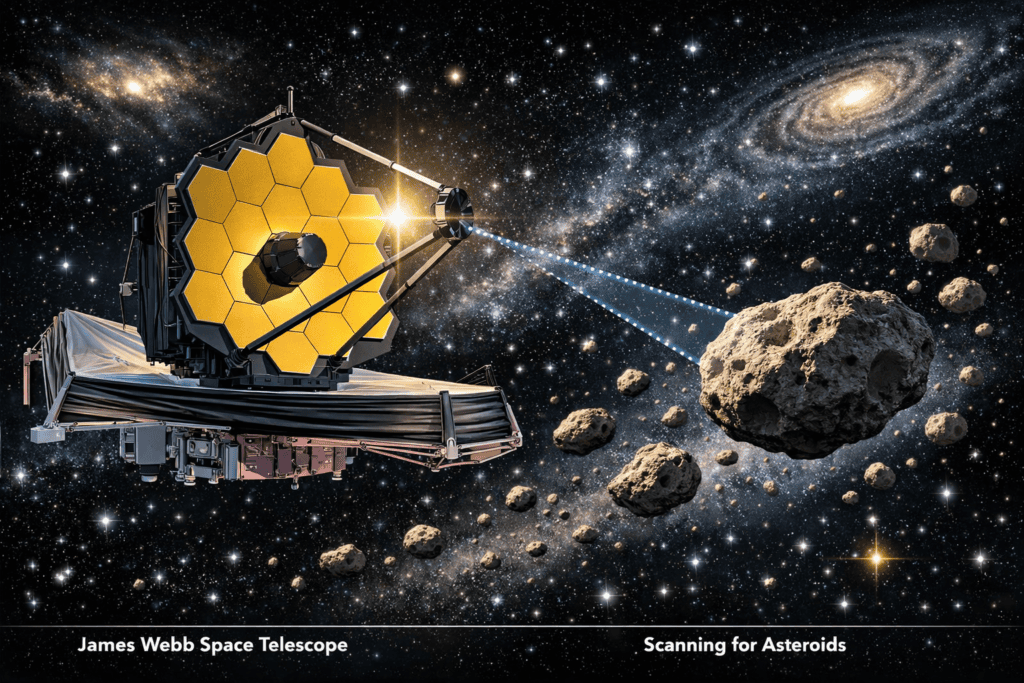
How the James Webb Space Telescope Detects Asteroids
The James Webb Space Telescope (JWST) is currently the most powerful infrared telescope ever launched. Although its primary mission is studying distant galaxies, it is also extremely effective for observing asteroids, comets, and planetary objects.
More details about the telescope can be found at
https://jwst.nasa.gov
Infrared Detection Technology
One of the key advantages of the James Webb Space Telescope asteroid detection capability is its infrared sensors.
Infrared observation allows astronomers to:
- Detect heat signatures of asteroids
- Study surface minerals
- Measure asteroid temperature
- Analyze dust and chemical composition
This technology makes it easier to observe small or dark asteroids that are difficult to detect with traditional optical telescopes.
Precision Asteroid Tracking
Using advanced imaging systems, JWST can track moving objects across large distances in space.
Accurate tracking allows scientists to calculate asteroid orbits and determine whether they may pass close to Earth.

Why Asteroid Tracking is Important
Monitoring asteroids such as Asteroid 2024 YR4 is a critical part of planetary defense and space science.
Planetary Defense Systems
Some asteroids are classified as Potentially Hazardous Asteroids (PHAs) because their orbits cross Earth’s path.
Tracking these objects allows scientists to:
- Predict future close approaches
- Assess potential impact risks
- Develop asteroid deflection strategies
NASA’s planetary defense initiatives are explained here
https://www.nasa.gov/planetarydefense/overview
Studying the Origins of the Solar System
Asteroids are considered cosmic fossils because they preserve material from the early solar system.
Studying them helps scientists understand:
- Planet formation
- Distribution of minerals in space
- Origins of water on Earth
Many scientists believe asteroids may have delivered organic molecules necessary for life.
Technologies Used to Study Asteroids
Modern astronomy uses several technologies to study objects like Asteroid 2024 YR4.
Spectroscopy
Spectroscopy analyzes how asteroids reflect sunlight across different wavelengths.
This helps identify minerals such as:
- Iron
- Nickel
- Silicates
- Carbon compounds
Spectroscopy research is widely used by astronomers studying asteroid composition.
Radar Asteroid Imaging
Radar systems allow scientists to map the shape and surface features of asteroids.
This technology helps determine:
- Size
- Spin rate
- Surface structure
Space Missions to Asteroids
Several missions have successfully visited asteroids.
Examples include:
- NASA OSIRIS‑REx mission to asteroid Bennu
- Japan’s Hayabusa2 mission
These missions returned asteroid samples that scientists continue studying.
More information about OSIRIS‑REx can be found at
https://www.nasa.gov/osiris-rex
Future of Asteroid Detection and Planetary Defense
The discovery of Asteroid 2024 YR4 highlights how rapidly space monitoring technology is advancing.
Artificial Intelligence in Astronomy
Artificial intelligence is now being used to scan telescope data and detect moving objects automatically.
AI systems can analyze millions of images and identify potential asteroids faster than traditional methods.
Planetary Defense Missions
Scientists are also developing technologies to protect Earth from asteroid impacts.
A recent example is NASA’s DART mission, which successfully tested asteroid deflection.
More about the DART mission
https://dart.jhuapl.edu
Next‑Generation Space Observatories
Future observatories will improve our ability to detect even smaller asteroids earlier.
What is Asteroid 2024 YR4?
Asteroid 2024 YR4 is a newly identified near‑Earth asteroid detected by asteroid monitoring programs and studied using modern space telescopes such as the James Webb Space Telescope.
Is Asteroid 2024 YR4 dangerous?
Currently, astronomers track objects like Asteroid 2024 YR4 to determine their orbit and ensure they do not pose a threat to Earth.
How do scientists detect asteroids?
Scientists detect asteroids using telescopes, automated sky surveys, radar observations, and space‑based observatories such as the James Webb Space Telescope.
Conclusion
The discovery and observation of Asteroid 2024 YR4 highlight the importance of modern asteroid detection technologies and global planetary defense efforts.
With advanced tools like the James Webb Space Telescope, artificial intelligence systems, and asteroid tracking programs, scientists can monitor near‑Earth objects more accurately than ever before.
These discoveries not only improve planetary safety but also provide valuable insights into the formation of our solar system.
As technology continues to evolve, the study of asteroids will remain a vital part of space science and planetary defense.