

Introduction
The phrase “asteroid hit North Sea tsunami” may sound like a dramatic headline from a disaster movie, but it is actually based on real scientific discoveries. Recent geological research has provided strong evidence that a massive asteroid struck the North Sea millions of years ago, creating an enormous tsunami that may have reached heights of more than 330 feet (100 meters).
This ancient cosmic impact occurred long before humans existed, yet it left behind powerful geological clues hidden beneath the seabed. Scientists now believe that the mysterious Silverpit Crater, buried deep below the North Sea, was formed when a large asteroid slammed into the shallow ocean during the Eocene epoch, roughly 43–46 million years ago.
The discovery has sparked global interest among scientists because it reveals how asteroid impacts can create catastrophic ocean waves capable of reshaping coastlines and ecosystems. Studying this event helps researchers understand Earth’s geological history and also prepares humanity for potential asteroid threats in the future.
The Ancient Event: When an Asteroid Hit the North Sea
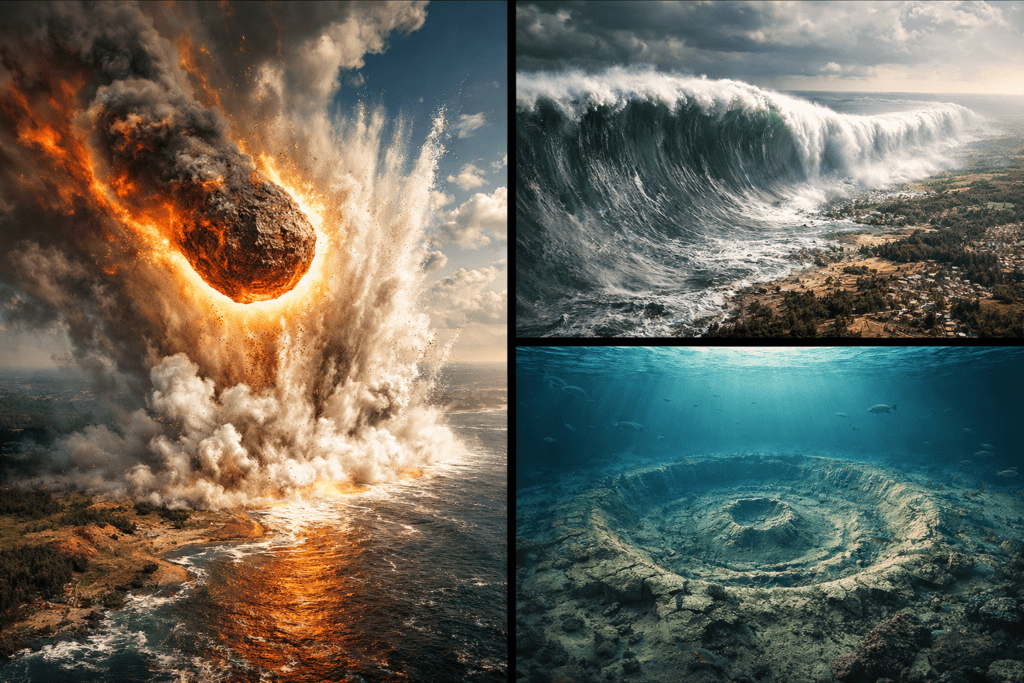
Around 45 million years ago, Earth experienced a dramatic cosmic event. A large asteroid, estimated to be around 150–200 meters wide, entered Earth’s atmosphere and crashed into the waters of what is now the North Sea, located between the United Kingdom and mainland Europe.
When the asteroid struck the ocean, it was traveling at incredible speeds—possibly over 70,000 kilometers per hour. The impact released enormous amounts of energy, comparable to multiple nuclear explosions occurring simultaneously.
As the asteroid hit the water, it displaced an enormous volume of ocean, instantly forcing seawater outward and upward. The collision also blasted rock, sediment, and water high into the atmosphere.
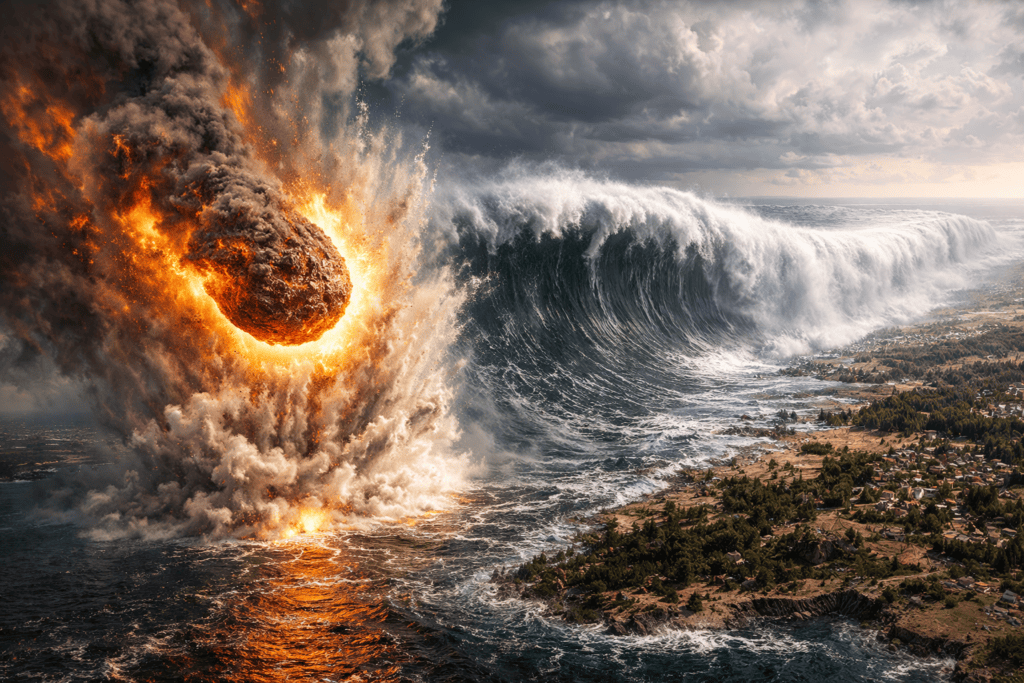
The result of this powerful event was a massive tsunami, which scientists estimate may have reached heights of up to 330 feet. Such waves would have spread rapidly across the surrounding seas and coastlines.
Although no humans existed at the time to witness the event, geological evidence suggests the waves dramatically reshaped the seafloor and coastal sediments.
https://www.sciencedaily.com/releases/2026/03/260311004836.htm
The Silverpit Crater Mystery
The key piece of evidence behind the asteroid hit North Sea tsunami theory lies beneath the seabed. Scientists discovered a massive circular structure called the Silverpit Crater in the southern North Sea.
This crater was first identified in 2002 using seismic imaging data collected during oil and gas exploration. At first, scientists were unsure what caused the unusual circular formation.
Some researchers believed the structure may have formed due to salt movement beneath the seabed, while others suspected it could be an ancient asteroid impact crater.
After years of debate and further research, scientists have gathered strong evidence suggesting the crater was indeed formed by a cosmic impact.
Key Features of the Silverpit Crater
The Silverpit structure has several characteristics typical of asteroid impact craters:
- A circular crater about 20 kilometers wide
- Multiple concentric rings surrounding the crater
- Disturbed sediment layers beneath the seabed
- Evidence of extreme pressure in nearby rocks
These features strongly suggest that a powerful external force—such as an asteroid collision—created the crater.
https://www.sciencedaily.com/releases/2026/03/260311004836.htm
How the Asteroid Created a Mega Tsunami
When scientists studied the potential impact scenario, they used computer simulations to understand what would happen if a large asteroid struck shallow ocean water.
Their models revealed that when a large asteroid hits the sea, the impact produces a massive explosion of water and rock. The ocean surface is pushed outward violently, creating a gigantic wave that spreads rapidly in all directions.
In the case of the asteroid hit North Sea tsunami, researchers estimate the first wave could have been more than 100 meters high.
To put this into perspective:
- A 100-meter wave is taller than a 30-story building
- It is several times higher than most historic tsunamis
- It would carry enormous destructive power
The tsunami would likely have traveled across the North Sea basin and impacted coastlines across parts of northern Europe, including areas that are now part of the United Kingdom, Norway, Denmark, and the Netherlands.
However, because the impact occurred millions of years ago, these regions looked very different from today’s landscapes.
Geological Evidence of the Impact
Scientists rely on several types of geological evidence to confirm ancient asteroid impacts.
In the case of the asteroid hit North Sea tsunami, researchers analyzed seismic data, sediment layers, and mineral structures.
1. Seismic Imaging
Seismic imaging uses sound waves to map underground structures beneath the ocean floor. Oil exploration companies collect this data to locate energy resources, but scientists can also use it to study geological formations.
The seismic images of the North Sea revealed a large circular depression surrounded by rings—one of the classic signs of an asteroid impact crater.
2. Shocked Minerals
Another important clue comes from shocked minerals, which form when rocks are exposed to extremely high pressure and temperature.
These minerals often appear when meteorites or asteroids collide with Earth. Their presence strongly supports the idea that the Silverpit crater formed during a powerful impact event.
3. Computer Simulations
Scientists also used advanced computer models to recreate the event. The simulations showed that an asteroid of the estimated size hitting shallow ocean water could produce both the crater structure and the giant tsunami waves.
Together, these findings provide strong support for the asteroid hit North Sea tsunami hypothesis.
What Would Happen If an Asteroid Hit the Ocean Today?
The discovery of this ancient event raises an important question: what would happen if a similar asteroid struck Earth today?
Although such events are rare, they are scientifically possible.
If an asteroid around 150–200 meters wide hit the ocean today, it could generate a powerful tsunami capable of causing significant coastal damage.
Potential consequences might include:
- Massive ocean waves hitting coastal cities
- Severe flooding of low-lying regions
- Destruction of infrastructure
- Disruption of shipping routes
- Economic and environmental damage
Fortunately, modern technology allows scientists to track many potentially dangerous asteroids before they reach Earth.
Global Efforts to Track Dangerous Asteroids
Space agencies around the world actively monitor near-Earth objects to detect possible impact threats.
Several major programs are responsible for identifying and tracking asteroids.
NASA Planetary Defense Program
NASA operates a dedicated Planetary Defense Coordination Office that tracks asteroids that could potentially collide with Earth.
Pan-STARRS Telescope System
The Pan-STARRS observatory in Hawaii scans the sky every night searching for moving objects such as asteroids and comets.
Catalina Sky Survey
Another major asteroid detection program is the Catalina Sky Survey, which has discovered thousands of near-Earth objects.
Asteroid Deflection Experiments
In 2022, NASA successfully demonstrated a planetary defense technique through the DART mission, which intentionally crashed a spacecraft into an asteroid to change its orbit.
These efforts aim to ensure humanity can detect potential asteroid threats years—or even decades—in advance.
Why Scientists Study Ancient Asteroid Impacts
Studying events like the asteroid hit North Sea tsunami provides valuable insights into Earth’s history and the behavior of asteroid impacts.
Researchers analyze ancient impacts for several reasons:
Understanding Earth’s Geological Evolution
Asteroid impacts have played a major role in shaping Earth’s surface. Large collisions can create craters, alter landscapes, and influence ecosystems.
Studying Ocean Tsunami Formation
Impacts in oceans help scientists understand how large waves form and propagate across the seas.
Improving Planetary Defense
By studying past impacts, scientists can improve their models of how asteroids behave when they enter Earth’s atmosphere or strike the planet.
This knowledge helps governments and space agencies prepare for potential future threats.
Could Another Asteroid Create a Mega Tsunami?
Although asteroid impacts large enough to create mega-tsunamis are rare, they are not impossible.
Earth is constantly bombarded by small space rocks, though most burn up in the atmosphere before reaching the ground.
However, larger asteroids—those more than 100 meters wide—are powerful enough to cause regional destruction if they strike land or ocean.
Fortunately, astronomers have already discovered and cataloged many of the largest near-Earth asteroids.
Current observations suggest that no known asteroid poses a major threat to Earth in the near future.
Nevertheless, scientists continue to monitor the skies carefully.
Lessons from the Asteroid Hit North Sea Tsunami
The discovery of the ancient asteroid hit North Sea tsunami highlights the incredible forces that have shaped Earth throughout its history.
Even though the event occurred tens of millions of years ago, its effects remain visible beneath the ocean floor today.
This discovery reminds us that Earth is part of a dynamic cosmic environment where asteroid impacts—though rare—have played an important role.
Studying these events helps scientists learn more about Earth’s past and better prepare for possible future cosmic hazards.
Conclusion
The confirmation that an asteroid hit the North Sea and triggered a massive tsunami millions of years ago provides fascinating insight into Earth’s geological history.
The mysterious Silverpit Crater beneath the seabed is likely the result of this powerful cosmic collision. Scientists estimate that the impact generated a tsunami more than 330 feet high, sending enormous waves across ancient seas.
While the event occurred long before human civilization, its discovery is an important reminder of the powerful forces that shape our planet.
Thanks to modern astronomy and planetary defense programs, scientists are now better equipped than ever to detect and monitor asteroids that could potentially threaten Earth.
The study of ancient impacts like the asteroid hit North Sea tsunami not only reveals secrets of our planet’s past but also helps humanity prepare for the future.