
Can the Iran US Israel war turn a tense region into a full-blown global crisis?
In the last few years, tensions have jumped from shadow clashes to open strikes, disrupting trade routes, raising oil prices, and dragging more countries into the conflict.
This article explains the Iran-US-Israel war in simple language, using real-world examples, recent events, and expert insights, so you can clearly understand what is happening and why it matters to you, wherever you live.
What Is the Iran US Israel War?
The “Iran US Israel war” is not just one battle but a complex, ongoing conflict involving direct attacks, cyber operations, and a web of proxy groups across the Middle East.
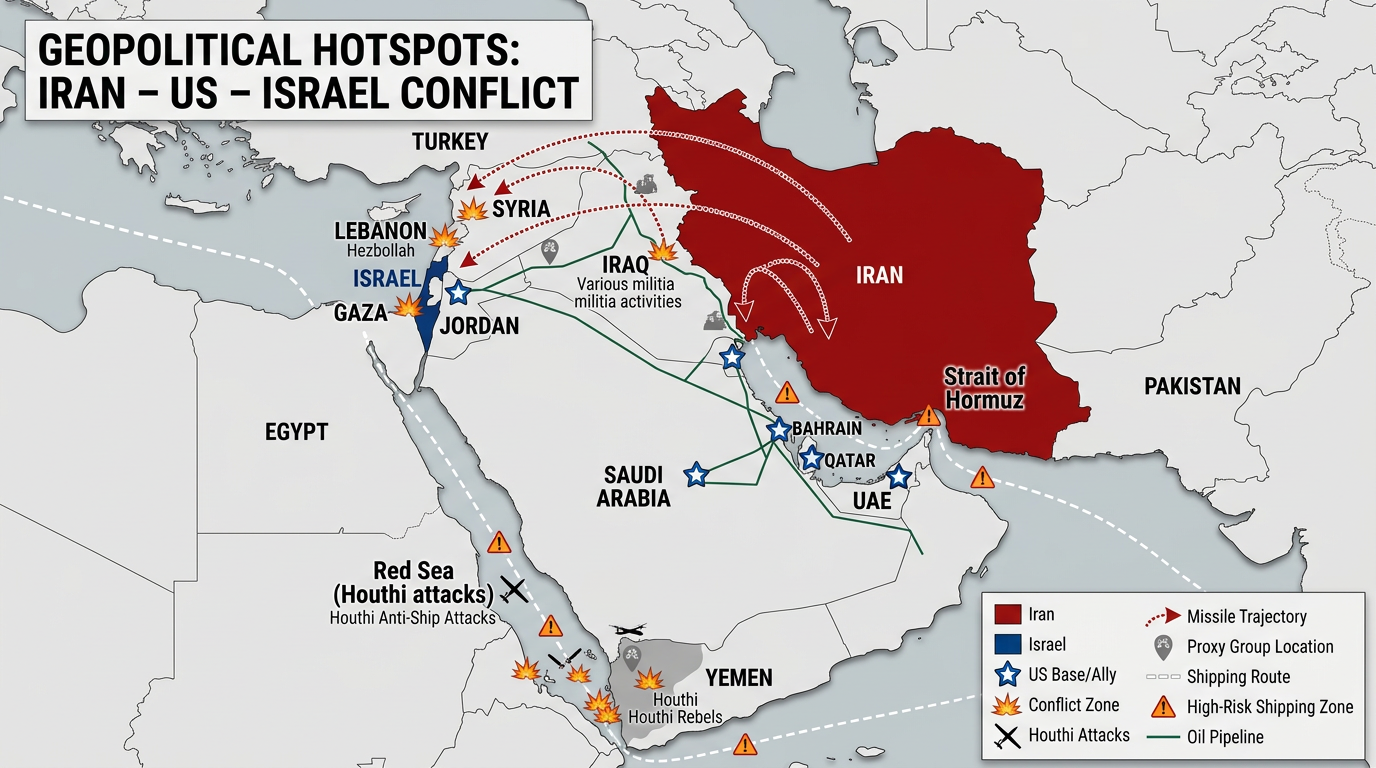
It links together tensions between Iran and Israel, long-running hostility between Iran and the United States, and local wars in places like Gaza, Syria, Yemen, Iraq, and Lebanon.
For years, Iran and Israel mostly fought in the shadows through covert operations and proxy forces, but since 2024 there have been open, direct strikes between the two countries, pulling the US deeper into the confrontation.
This shift from “cold” shadow conflict to more open warfare is what makes the Iran US Israel war especially dangerous today.
Short History of the Tensions
The roots of the conflict go back to Iran’s 1979 Islamic Revolution, which turned Iran into an anti-Western, anti-Israel Islamic republic and ended formal ties with the United States.
Over time, clashes spread into Lebanon, Syria, Iraq, and Yemen, where Iran built up powerful allied militias such as Hezbollah in Lebanon and the Houthi movement in Yemen.
Israel sees Iran’s regional network and missile program as an existential threat, while Iran views Israel and the US as enemies trying to topple its regime.
This mutual fear and distrust has created a cycle of attack and counterattack that now risks evolving into a long regional war.
How the Gaza War and Syria Front Feed Into It
The Gaza war after October 2023 triggered a new wave of escalation, as Iran‑aligned groups such as Hezbollah in Lebanon and the Houthis in Yemen opened additional fronts against Israel and its partners.
Iran blamed Israel for attacks on its interests in Syria, including a deadly strike on an Iranian diplomatic site in Damascus in April 2024, which killed senior Iranian officers.
In response, Iran launched a massive drone and missile attack on Israel in April 2024—its first direct strike on Israeli territory—marking a clear turning point in the Iran US Israel war.
Causes and Background of the Iran US Israel War
At the heart of the Iran US Israel war are three big issues: ideology, nuclear ambitions, and regional power.
Ideology and Regime Survival
Iran’s leadership is built around an Islamic revolutionary ideology that rejects the US and Israel as hostile powers, while Israel defines Iran as its top strategic threat.
For Iran’s ruling elite, standing up to the US and Israel is part of their identity and their claim to legitimacy at home.
Israel, on the other hand, sees Iran’s calls for its destruction and its support for armed groups on Israel’s borders as proof that the Iranian regime cannot be trusted with advanced weapons.
This ideological clash makes compromise difficult and turns every negotiation into a struggle over prestige and survival, not just policy.
Nuclear Program and Security Fears
Iran’s nuclear program has been at the center of disputes for over two decades, with Western countries and Israel fearing that Tehran could move from civilian nuclear technology toward building a bomb.
Earlier agreements to limit Iran’s nuclear activities collapsed, and renewed US‑Iran talks in 2025–2026 were tense and short‑lived, with strict deadlines and heavy pressure.
According to reporting on those talks, the US pushed hard for a new nuclear deal while Israel lobbied strongly against any compromise and prepared military options against Iranian facilities.
When the diplomatic track faltered, Israel carried out large‑scale strikes on Iranian nuclear and military sites, triggering a wider war.
Proxy Networks Across the Region
Instead of only confronting each other directly, Iran and its rivals have built proxy networks that fight in multiple countries.
Key Iran‑aligned groups include:
- Hezbollah in Lebanon, a powerful militia and political actor that has fired rockets at Israel and clashed repeatedly with Israeli forces.
- Shia militias in Iraq and Syria, which have targeted US bases and worked closely with Iran’s Islamic Revolutionary Guard Corps (IRGC).
- The Houthi movement in Yemen, which has attacked ships in the Red Sea and claimed solidarity with Palestinians in Gaza while receiving Iranian political and material support, according to US and allied officials.
These groups allow Iran to put pressure on Israel and the US without always firing directly from its own territory, but they also make the Iran US Israel war harder to control, because each front can escalate in different ways.
Latest Updates and Trends in the Iran US Israel War
Iran’s April 2024 Drone and Missile Barrage
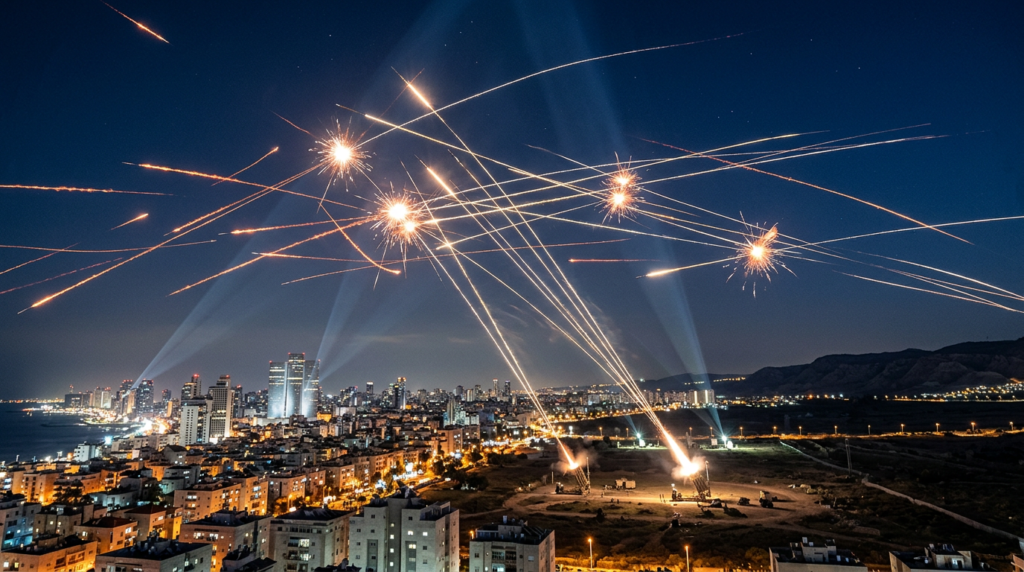
On 13–14 April 2024, Iran launched an unprecedented drone and missile attack on Israel, sending hundreds of drones, cruise missiles, and ballistic missiles toward Israeli territory and the occupied Golan Heights.
Western and Israeli sources reported that over 300 projectiles were fired, with Israel and its partners intercepting the vast majority in the air.
Iran said this operation—codenamed “Operation True Promise”—was revenge for an earlier Israeli strike on an Iranian consulate building in Damascus, which had killed senior IRGC commanders.
The attack marked the first direct, large‑scale strike from Iranian soil on Israel, raising open fears of a region‑wide war.
The 12‑Day War in 2025
Tensions rose again in June 2025 when Israel launched major attacks on Iranian targets, including nuclear facilities and key military infrastructure, in what some sources describe as the “12‑Day War.”
These strikes reportedly killed top Iranian military officials and civilians, and led Iran to respond with missile launches and limited strikes aimed at Israel and selected US‑linked assets in the region.
Although a ceasefire stopped the fighting after around twelve days, the war left deep scars, strained Iran’s economy further, and weakened trust in diplomacy.
Nuclear negotiations, already fragile, collapsed as Iran suspended talks and accused its adversaries of using diplomacy as cover for regime‑change plans.
2026: Joint US–Israel Strikes and Wider Escalation
By early 2026, reports described a new phase: the United States and Israel carried out large joint strikes on Iran aimed at core security and political institutions, hoping to seriously weaken or even topple the regime.
Commentators warned that this was a huge gamble, with no clear plan for what might follow inside Iran and serious risks for US forces and allies across the region.
In response, Iran expanded its own operations, launching attacks across several countries and activating allied groups such as the Houthis, who threatened to resume large‑scale strikes on shipping in the Red Sea and the Persian Gulf.
Iranian forces also restricted shipping through the Strait of Hormuz for periods, threatening a chokepoint that carries about one‑fifth of global oil supplies.
Taken together, these developments show a clear trend: the Iran US Israel war has moved from a mostly hidden struggle to a region‑wide contest with direct attacks, proxy clashes, and powerful economic side effects.
Real‑World Impact of the Iran US Israel War
Oil Prices and Global Trade Routes
The Middle East is home to critical maritime chokepoints, especially the Red Sea–Suez Canal route and the Strait of Hormuz near the Persian Gulf.
Houthi attacks on commercial ships in the Red Sea, backed by Iranian political and material support according to US and allied officials, have already forced many shipping companies to reroute cargo around the Cape of Good Hope, adding cost and delay.
When Iran and its allies threaten or block shipping lanes, insurers raise premiums, shipping firms divert vessels, and energy prices can rise, affecting everything from fuel costs to food imports worldwide.
In early 2026, some carriers suspended Red Sea and Suez crossings again as the conflict intensified, underlining how directly the Iran US Israel war can hit global supply chains.
Impact on Civilians and Domestic Politics
Inside Iran, Israeli and US strikes have damaged infrastructure, killed high‑ranking commanders, and caused civilian casualties, fueling anger but also deep uncertainty and protests over the cost of continued confrontation.
In Israel, missile and drone threats have forced frequent air‑raid alerts and disruptions to daily life, particularly in northern areas and around sensitive military sites.
Across the region—in Lebanon, Syria, Iraq, and Yemen—local populations suffer from being battlegrounds for larger powers, dealing with displacement, economic hardship, and repeated airstrikes.
Domestic politics in all involved countries are increasingly shaped by the war narrative, leaving less room for compromise and more pressure on leaders to appear “tough.”
Role of Global Powers and Diplomacy
The United States remains Israel’s key security partner and is also a major player in Gulf security, which means it is deeply entangled in any conflict with Iran.
Attempts to restart nuclear talks in 2025–2026 struggled because Washington and Tehran had very different expectations, and each side used both sanctions and military threats as bargaining tools.
Other powers—such as European states, Russia, and China—have tried in different ways to reduce the risk of a full regional war, but their influence is limited when core security fears and ideology drive decisions.
As the Iran US Israel war widens, diplomats warn that a miscalculation could drag in even more actors and make any negotiated settlement harder to reach.
Case Studies and Real‑World Examples
Case Study 1: Red Sea Shipping Crisis
Since late 2023, Iran‑aligned Houthi rebels in Yemen have repeatedly attacked or threatened commercial vessels in the Red Sea, claiming they will target ships linked to Israel or its allies.
These actions have forced dozens of major shipping companies to halt or reroute traffic, severely disrupting one of the world’s busiest trade corridors connecting Europe and Asia.
To respond, the United States and partners launched naval missions like Operation “Prosperity Guardian” to protect shipping, while also carrying out strikes on Houthi targets inside Yemen.
However, each new attack and counterattack raises the risk that the Iran US Israel war at sea could spiral into a larger confrontation in and around the Red Sea and Gulf of Aden.
Case Study 2: The 12‑Day War Between Israel and Iran (2025)
In June 2025, Israel carried out a concentrated campaign against Iranian nuclear and military facilities, hitting sites tied to Iran’s missile program and leadership.
Iran responded with its own missile strikes and operations targeting Israel and some US‑linked assets, but the conflict was contained to roughly a twelve‑day period before a ceasefire took hold.
Analysts note that while the war was short, it had lasting consequences: nuclear talks broke down, Iran’s economy faced further strain, and both sides shifted toward long‑term “war of attrition” strategies rather than quick victories.
This case shows how even brief wars in the Iran US Israel conflict can reshape regional politics and make future diplomacy harder.
Case Study 3: A Business Owner Far From the Front Line
Imagine a small manufacturing company in India that imports machinery parts from Europe and exports finished goods to the Middle East and Africa.
When Red Sea shipping becomes risky, cargo is rerouted around Africa, adding weeks to shipping times and increasing freight costs.
Even though this business is far from Iran, the US, or Israel, it faces:
- Higher transport and insurance costs due to disrupted sea lanes
- Delays in receiving parts, slowing production
- Uncertainty in energy prices, affecting power and fuel bills
This illustrates how the Iran US Israel war, by hitting critical trade routes and oil flows, can directly affect ordinary businesses and families around the world, not just those living in conflict zones.
Expert Opinions on the Iran US Israel War
Security Analysts: A High‑Risk Gamble
Security experts warn that recent joint US–Israel strikes on Iran are a very high‑risk gamble intended to damage or even collapse the Iranian regime, but without a clear plan for what comes next.
They point out that targeting Iran’s core security institutions might weaken its leadership, yet could also create chaos, trigger harsher retaliation, or produce a more radical leadership instead.
Analysts also stress that the more fronts are active—Lebanon, Syria, Iraq, Yemen, the Red Sea—the greater the chance of miscalculation, where one local clash suddenly pulls the region into a wider war.
Economic Experts: Energy Market Shockwaves
Economists tracking shipping and oil markets highlight that threats to the Red Sea, Suez Canal, and Strait of Hormuz have already changed trade patterns and raised costs.
Some carriers have stopped using the Red Sea route entirely as attacks and warnings increase, pushing more traffic around the Cape of Good Hope and raising freight rates and delivery times.
Experts warn that a prolonged disruption or a serious incident in the Strait of Hormuz—through which about 20 percent of global crude oil flows—could trigger a sharp spike in global energy prices.
This would hit energy‑importing countries especially hard, adding inflation pressure and slowing economic growth.
Humanitarian Voices: Civilians Pay the Highest Price
Humanitarian organizations and regional observers emphasize that civilians in Iran, Israel, Gaza, Lebanon, Syria, Iraq, and Yemen are the ones paying the highest price.
Bombing campaigns, missile exchanges, and economic sanctions combine to create shortages, displacement, and psychological trauma in societies that have already lived through years of war.
These voices call for de‑escalation, strict protection of civilian areas, and renewed diplomatic channels—warning that a long Iran US Israel war could create a “lost decade” for development across much of the Middle East.
What This Means for Ordinary People
For Students and Working Professionals
Even if you live far from the Middle East, the Iran US Israel war can affect:
- Job markets, as companies face higher costs and weaker demand
- Study and work plans abroad, if visa rules, security conditions, or exchange programs change
- Daily expenses, especially fuel, transport, and imported goods
Understanding the conflict helps you interpret news headlines, make smarter financial decisions, and think critically about foreign policy debates.
For Investors and Businesses
For investors and business owners, the conflict highlights the importance of:
- Watching energy prices and shipping news, especially Red Sea and Gulf developments
- Diversifying supply chains to avoid over‑dependence on one route or region
- Considering geopolitical risk when planning long‑term investments
Companies in manufacturing, logistics, aviation, and energy‑heavy sectors should actively monitor how the Iran US Israel war and related sanctions or disruptions might change their cost base and delivery times.
Conclusion: The Future of the Iran US Israel War
The Iran US Israel war has moved far beyond hidden intelligence battles and local skirmishes.
Today it is a layered conflict—fought with missiles, drones, cyber tools, economic sanctions, and proxy forces—that shapes global trade routes, energy prices, and security debates.
In the near future, several paths are possible:
- A prolonged war of attrition, with regular limited strikes and cyber operations but no final breakthrough
- A dangerous escalation, if a miscalculation at sea or on land pushes major powers into direct, large‑scale confrontation
- A slow return to negotiations, if war fatigue, economic pain, and domestic pressure force leaders to seek a new nuclear and regional security framework
For now, the wisest approach for observers and citizens is to stay informed, understand how the Iran US Israel war connects to their own lives, and support efforts that reduce rather than expand the conflict.
The story is still being written—but the choices made in the next few years will decide whether this crisis becomes a turning point toward deeper chaos or a painful push toward a new, uneasy balance in the Middle East.