
Every year on March 14, the world pauses to celebrate Pi Day, a date that perfectly aligns with the first three digits of the most famous mathematical constant in history: 3.14. For science and tech bloggers, this isn’t just a day for eating delicious fruit pies; it is a profound recognition of the infinite nature of our universe. Whether you are a student, an engineer, or just someone who enjoys a good puzzle, Pi Day offers a unique opportunity to appreciate how a simple ratio—the circumference of a circle divided by its diameter—underpins almost everything we build, from the smallest computer chip to the largest suspension bridge.
What is Pi Day and Why Do We Celebrate It?
At its core, Pi Day is a tribute to $\pi$ (Pi), the Greek letter representing a number that never ends and never repeats. While we often shorten it to 3.14 for school assignments, the true value of $\pi$ is an “irrational” number that stretches into infinity. Because it is also a “transcendental” number, it cannot be solved by a simple algebraic equation, making it one of the most mysterious and beautiful figures in existence.
The Origins of the 3.14 Celebration
The tradition of Pi Day began in 1988 at the San Francisco Exploratorium. It was organized by physicist Larry Shaw, affectionately known as the “Prince of Pi,” who wanted to make mathematics more approachable. In 2009, the U.S. House of Representatives officially recognized the date, and by 2019, UNESCO proclaimed it the International Day of Mathematics.
A Day of Scientific Significance
It is no coincidence that Pi Day falls on March 14. Beyond the numerical alignment, the date marks the birthday of Albert Einstein, born in 1879, and the passing of Stephen Hawking in 2018. This convergence of mathematical and scientific milestones makes the day a global beacon for intellectual curiosity and scientific excellence.
How Pi Day Works: The Infinite Ratio
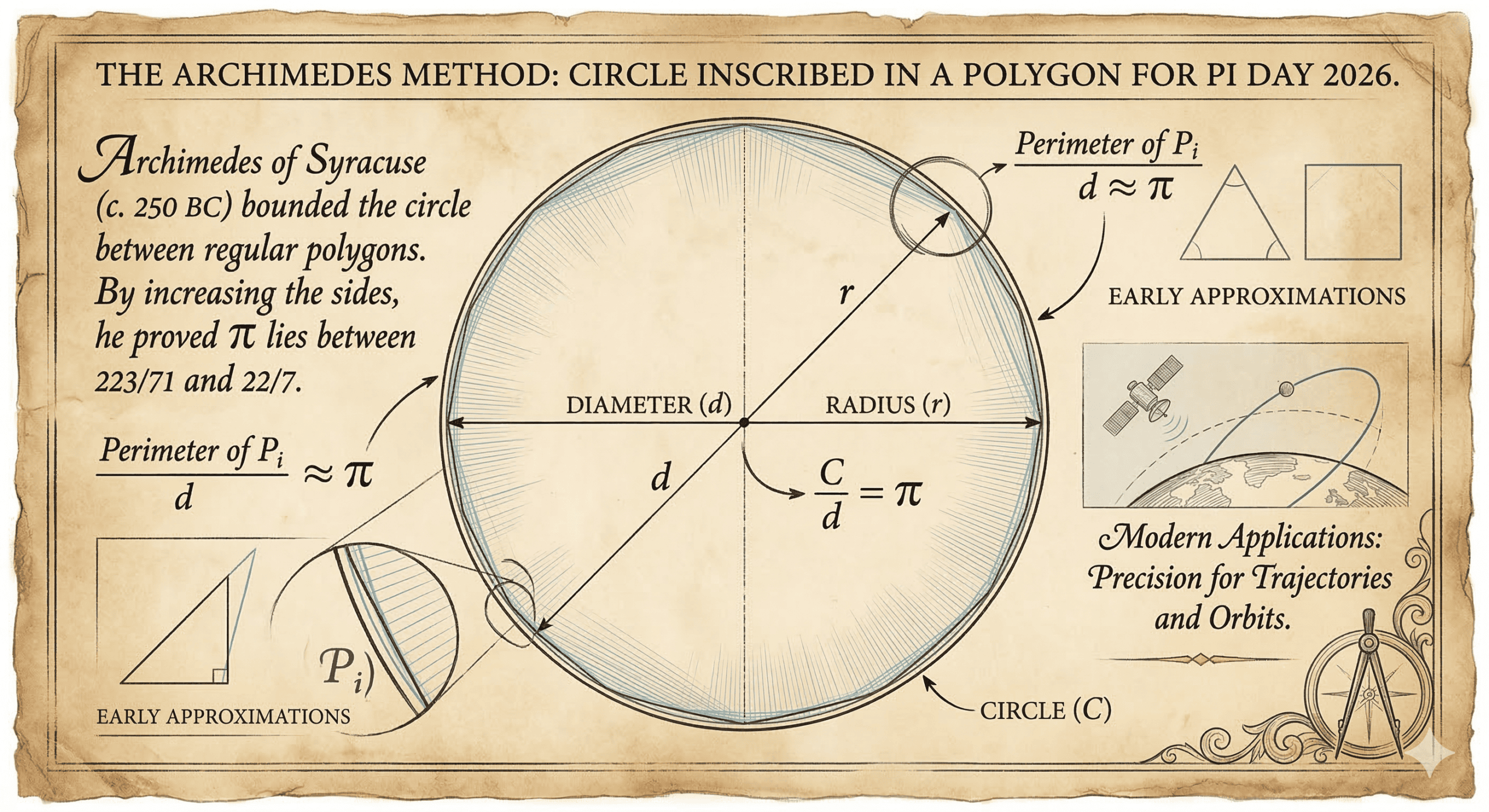
To understand Pi Day, one must understand the geometry of a circle. No matter how large or small a circle is—from a microscopic atom to a massive galaxy—the distance around it (the circumference) is always exactly $\pi$ times the distance across it (the diameter).
The Mathematical Definition of Pi
Mathematically, the relationship is expressed as:
$$C = \pi d$$
or
$$\pi = \frac{C}{d}$$
This constant ratio is the foundation of trigonometry and calculus. Without Pi Day math, we could not accurately measure the area of a circle ($\pi r^2$) or the volume of a sphere ($\frac{4}{3} \pi r^3$).
A 3,000-Year Search for Precision
Humanity has been obsessed with calculating the exact value of $\pi$ for millennia.
- Ancient Babylonians: Estimated it as $3.125$ over 4,000 years ago.
- Archimedes of Syracuse: In 250 B.C., he used a “polygon method,” using a 96-sided shape to prove $\pi$ was roughly $22/7$.
- The Indian Chapter: Mathematicians like Aryabhata and the Kerala school developed infinite series that edged closer to the modern value centuries before European calculus.
- Modern Supercomputers: As of 2026, computers have calculated $\pi$ to over 100 trillion digits.
Real-World Uses of Pi: Beyond the Classroom
While students often ask, “When will I ever use this?” the truth is that Pi Day celebrates a number that runs the modern world.
Space Exploration and NASA
When NASA engineers plan a mission to Mars, they use Pi Day principles to calculate trajectories. $\pi$ is essential for determining the volume of fuel tanks, the size of parachutes for Mars landers, and the orbits of satellites. Even a tiny error in $\pi$ could cause a spacecraft to miss its destination by miles.

Engineering and Construction
From the curves of a suspension bridge to the cylindrical storage tanks at refineries, engineers rely on Pi Day calculations to ensure structural integrity. Civil engineers use $\pi$ to determine the capacity of water tanks and the exact length of curved tunnels.
Medical Imaging and Science
In medicine, $\pi$ helps doctors understand the human body. It is used to calculate the blood flow through circular veins and is a fundamental part of the mathematics used in MRI and CT scans. It even appears in the structure of our DNA, where the double helix follows specific geometric ratios.
Future Impact: Pi in the Age of 2026 Technology
As we look toward the future, Pi Day remains relevant in cutting-edge fields like Quantum Computing and renewable energy.
Quantum Computing and Qubits
Quantum computers process information using “qubits” that exist in a state of superposition. Calculating these states involves complex wave functions. Since waves are essentially oscillations around a circle, $\pi$ is the primary constant used to program these super-fast computers.
The “Green Tech” and Battery Revolution
In the tech world, energy density is key to the 2026 EV revolution. Designing the cylindrical cells within Solid-State Battery Technology requires precise $\pi$ calculations to maximize storage space and minimize heat.
Interactive Ways to Celebrate Pi Day 2026
Since Pi Day 2026 falls on a Saturday, it is the perfect time for community-driven activities.
- Pi Recitation Contest: The world record is over 70,000 digits! Challenge yourself to learn the first 50.
- Pi Day Run: Many communities host a “Pi Run” of 3.14 miles (roughly a 5K).
- Pi-ku Poetry: Write a poem where the number of syllables in each line follows the digits of $\pi$ (3, 1, 4, 1, 5…).
- Pi Day Scavenger Hunt: Find objects that measure exactly 3.14 in their $C/d$ ratio.
Fascinating Trivia: Did You Know?
- The Symbol: The symbol $\pi$ wasn’t used until 1706 by William Jones, and it became popular thanks to Leonhard Euler.
- Mirror Image: If you hold a mirror to the numbers “3.14”, it spells out “PIE”.
- Computing Feat: In 2024, a team calculated 139 digits of $\pi$ by hand just to prove it could still be done without a computer.
- Crop Circles: In 2008, a mysterious crop circle appeared in England that perfectly encoded the first 10 digits of $\pi$.
Conclusion: Why We Need Pi Day More Than Ever
In a world increasingly driven by data and AI, Pi Day serves as a vital reminder that mathematics is the universal language of hope and progress. The theme for Pi Day 2026, “Mathematics and Hope,” highlights how logical thinking can help us solve global challenges like climate change and disease. It is a day to celebrate not just a number, but the human drive to explore the infinite.
Whether you spend the day memorizing digits, baking a circular treat, or simply marveling at the geometry of a seashell, remember that Pi Day is a celebration of the infinite possibilities of the human mind. It proves that even in a finite world, we can touch the infinite through the power of numbers.