Introduction
If you have ever stared at a black‑hole image and wondered whether it can really live forever, you are already halfway to asking the right question: how are Hawking radiation and black hole evaporation explained simply? In the 1970s, Stephen Hawking shocked the physics world by showing that black holes are not perfectly black – quantum effects make them emit a faint glow of particles now called Hawking radiation.
Because of this emission, black holes slowly lose mass and, over unimaginably long times, can completely disappear in a process known as black hole evaporation. In this guide, you will see Hawking radiation and black hole evaporation explained simply, with clear analogies, real‑world numbers, and up‑to‑date research so you can follow the story even if you are not a physicist.
What Are Hawking Radiation and Black Hole Evaporation?
Basic definitions
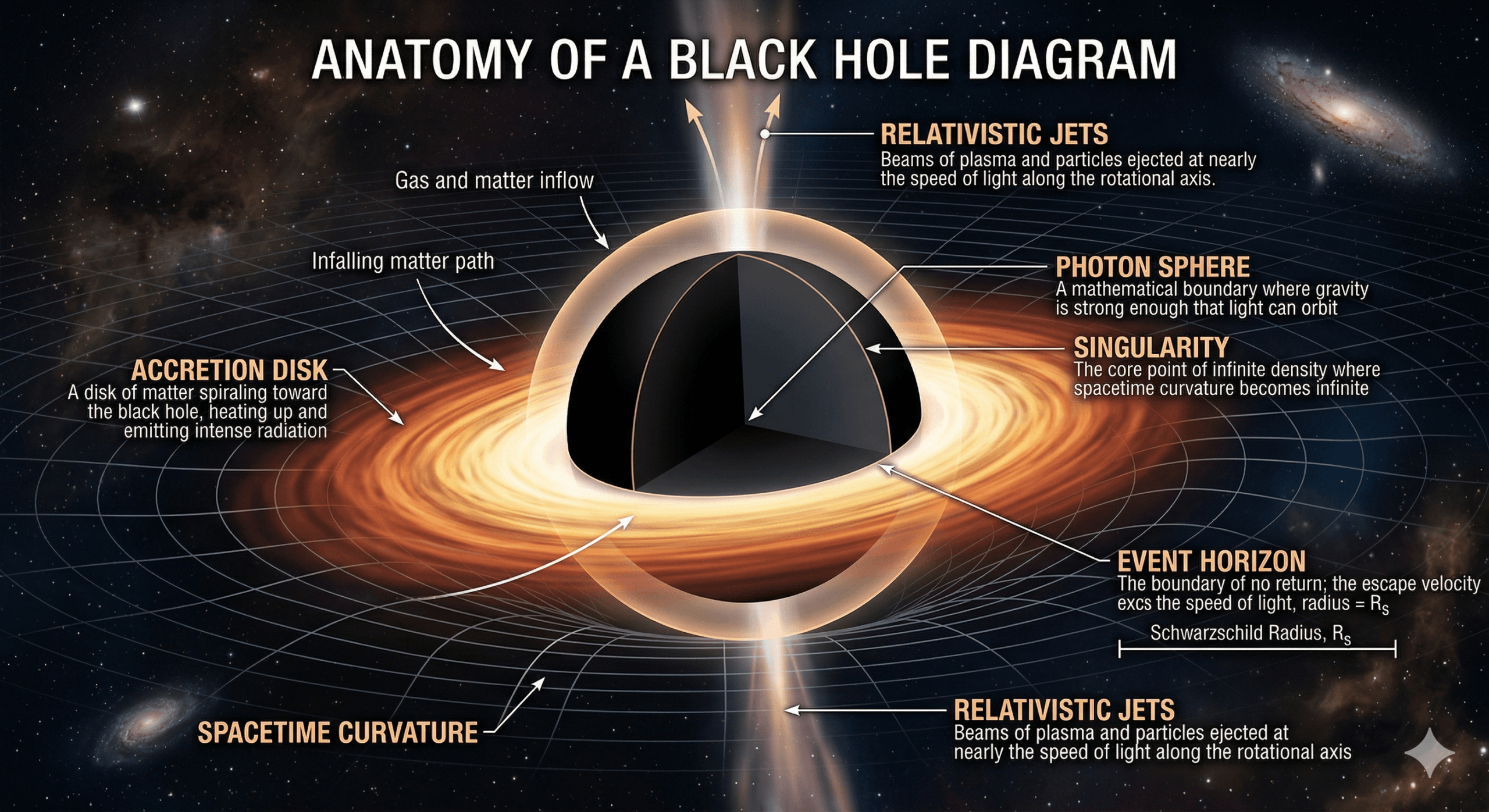
At its core, Hawking radiation is a very faint stream of particles that a black hole emits because of quantum effects near its event horizon. These particles can be photons (light), neutrinos, and other elementary particles depending on the black hole’s temperature.
Black hole evaporation is the long‑term process in which a black hole loses mass due to Hawking radiation until it eventually disappears. As the black hole radiates energy, it must pay an “energy debt” by giving up part of its mass, in line with Einstein’s famous relation between mass and energy.
Why this matters
Putting Hawking radiation and black hole evaporation together bridges three pillars of modern physics: quantum mechanics, general relativity, and thermodynamics. Understanding Hawking radiation and black hole evaporation explained simply helps you see how deep questions about information, entropy, and even the fate of the universe are tightly connected to these strange objects.
Stephen Hawking’s Big Idea in Plain English
In 1974, Stephen Hawking used tools from quantum field theory in curved spacetime to show that black holes are not totally black; instead, they emit thermal radiation with a temperature inversely proportional to their mass. This was revolutionary, because until then black holes were thought of as perfect sinks from which nothing, not even light, could escape.
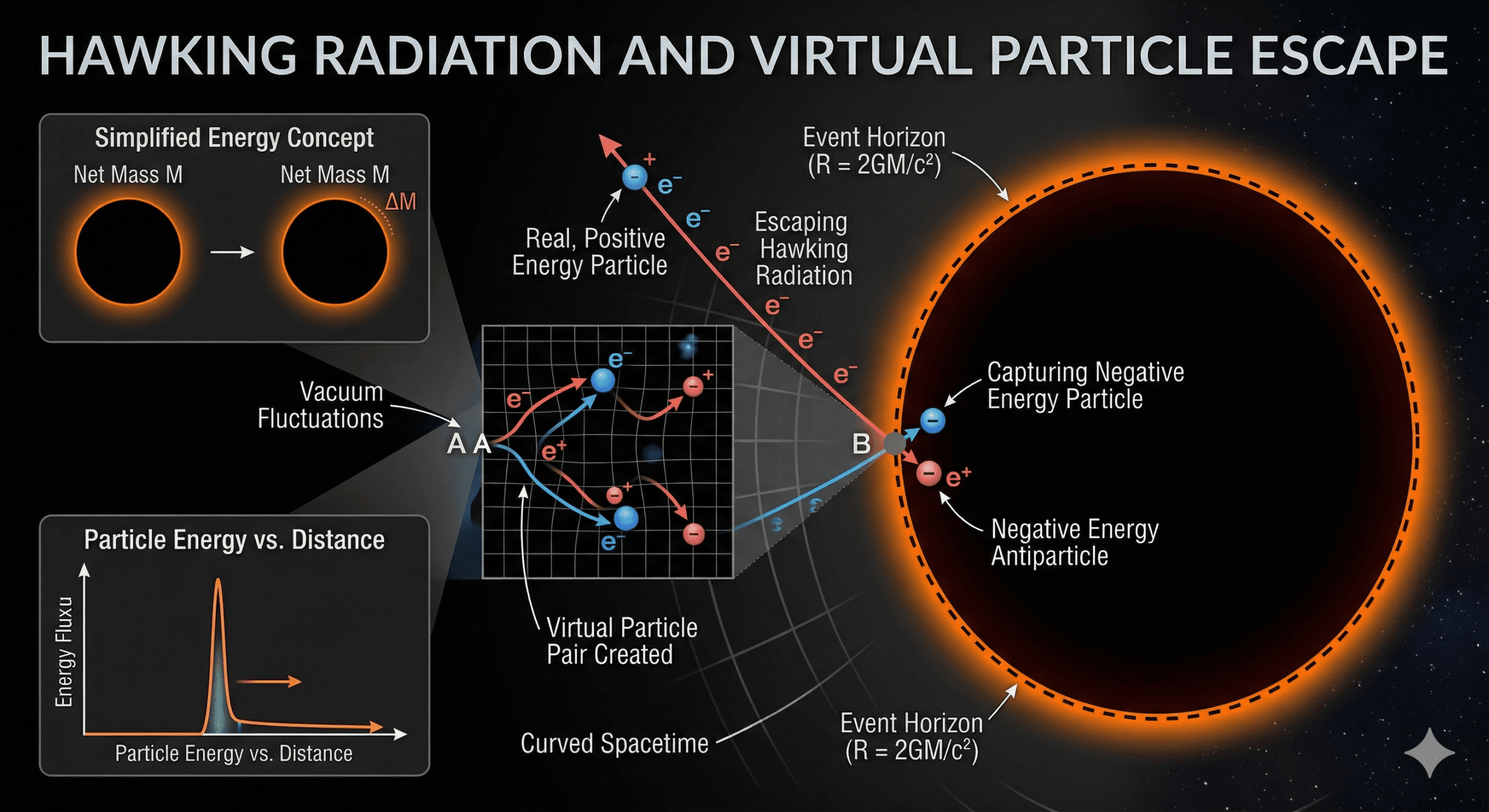
Hawking’s idea rests on the fact that empty space is not truly empty. According to quantum theory, the vacuum constantly produces short‑lived pairs of particles and antiparticles, known as virtual particles, which normally annihilate and return their borrowed energy almost instantly. Hawking asked what happens when such pairs form right at the event horizon of a black hole.
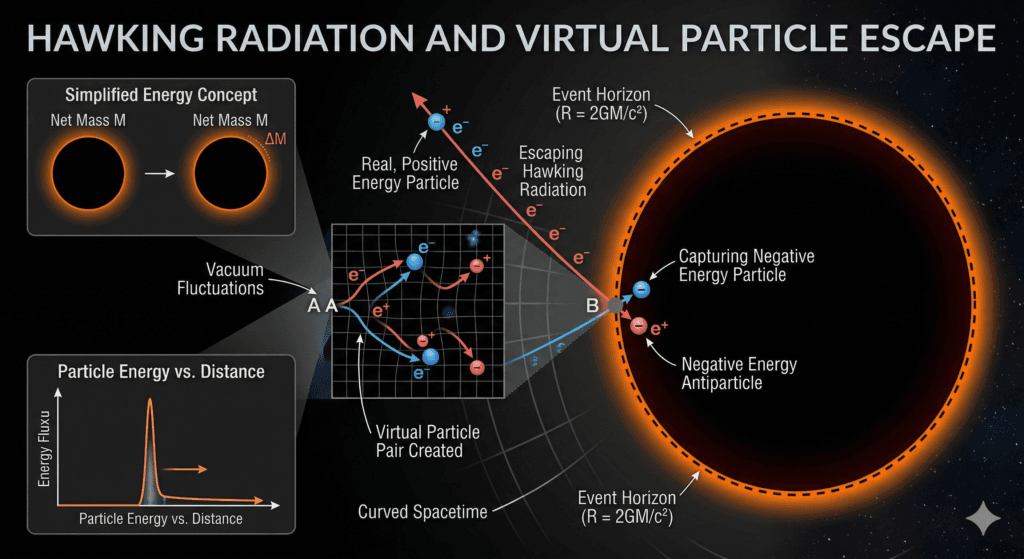
In the popular explanation, sometimes one member of the pair falls into the black hole while the other escapes, showing Hawking radiation and black hole evaporation explained simply with a visual picture. Although the full calculation is more subtle and does not literally rely on particles “popping out” at the horizon, the end result matches the intuition: the black hole loses mass while emitting radiation that looks thermal to distant observers.
Expert insight: Modern expositions stress that Hawking radiation comes from quantum fields defined over the entire curved spacetime, not from particles being created exactly at the horizon. The virtual‑pair story is a helpful cartoon, but the rigorous derivation uses sophisticated mathematics.
How Hawking Radiation and Black Hole Evaporation Work (Explained Simply)
Step‑by‑step picture
To see Hawking radiation and black hole evaporation explained simply, it helps to follow a step‑by‑step story:
- Quantum vacuum fluctuations happen everywhere in space. Particle–antiparticle pairs appear briefly and then annihilate, returning borrowed energy to the vacuum.
- Near the event horizon, spacetime is strongly curved. The gravitational field separates the two particles in a pair more easily than in flat space.
- One particle falls in, the other escapes. In the simplified picture, if one particle crosses the horizon and the other escapes to infinity, they never meet again to annihilate.
- Energy bookkeeping: The infalling particle effectively has negative energy relative to the outside universe, so when it falls in, it reduces the black hole’s mass.
- Escaping radiation: The particle that escapes becomes part of the Hawking radiation seen by distant observers, carrying away positive energy.
- Long‑term evaporation: Over incredibly long times, this steady trickle of energy loss shrinks and ultimately evaporates the black hole.
Even though this narrative simplifies the real mathematics, it captures the key idea that underlies Hawking radiation and black hole evaporation explained simply: gravity bends quantum fields in such a way that black holes leak energy instead of keeping it all forever.
Temperature of a black hole
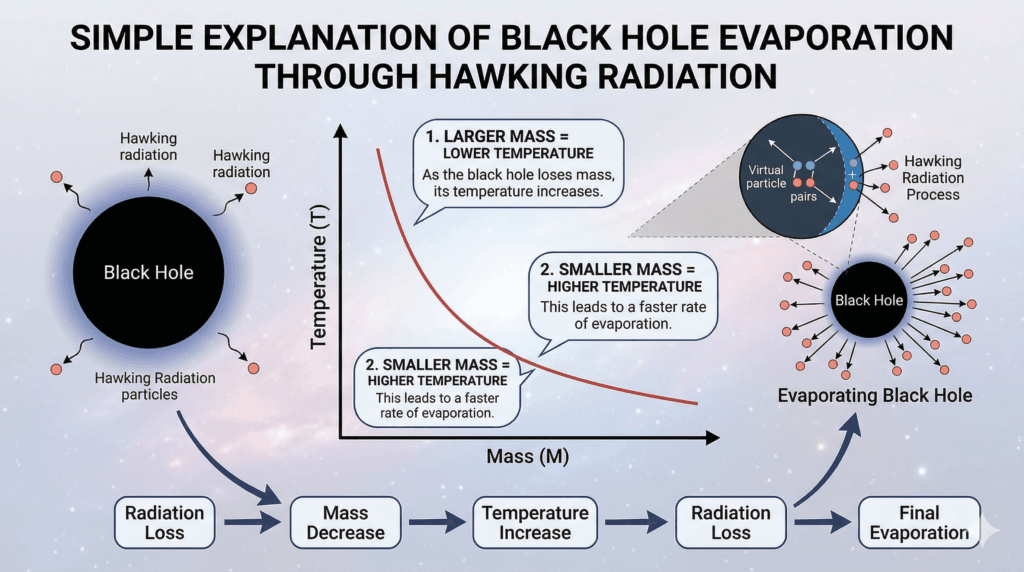
Hawking’s calculation shows that a black hole has a temperature inversely proportional to its mass; in other words, a smaller black hole is hotter and radiates more, while a larger black hole is colder and radiates less. For a black hole with the mass of the Sun, the Hawking temperature is only around a few ten‑billionths of a kelvin – far colder than the cosmic microwave background – which makes its radiation essentially impossible to detect with current instruments.
This mass–temperature relation is the first step in seeing Hawking radiation and black hole evaporation explained simply: if smaller black holes are hotter, they lose mass faster, and that sets up a runaway process in the final stages where the black hole evaporates in a violent burst.
Why Smaller Black Holes Evaporate Faster
The mass–temperature–lifetime connection
Three key relationships help you understand Hawking radiation and black hole evaporation explained simply:
- Temperature ∝ 1 / mass: Small mass → high temperature → stronger radiation.
- Power output grows as mass decreases: As the black hole shrinks, each emitted quantum carries more energy, and the rate of energy loss grows rapidly.
- Lifetime ∝ mass³: The time it takes for a black hole to evaporate grows roughly with the cube of its starting mass.
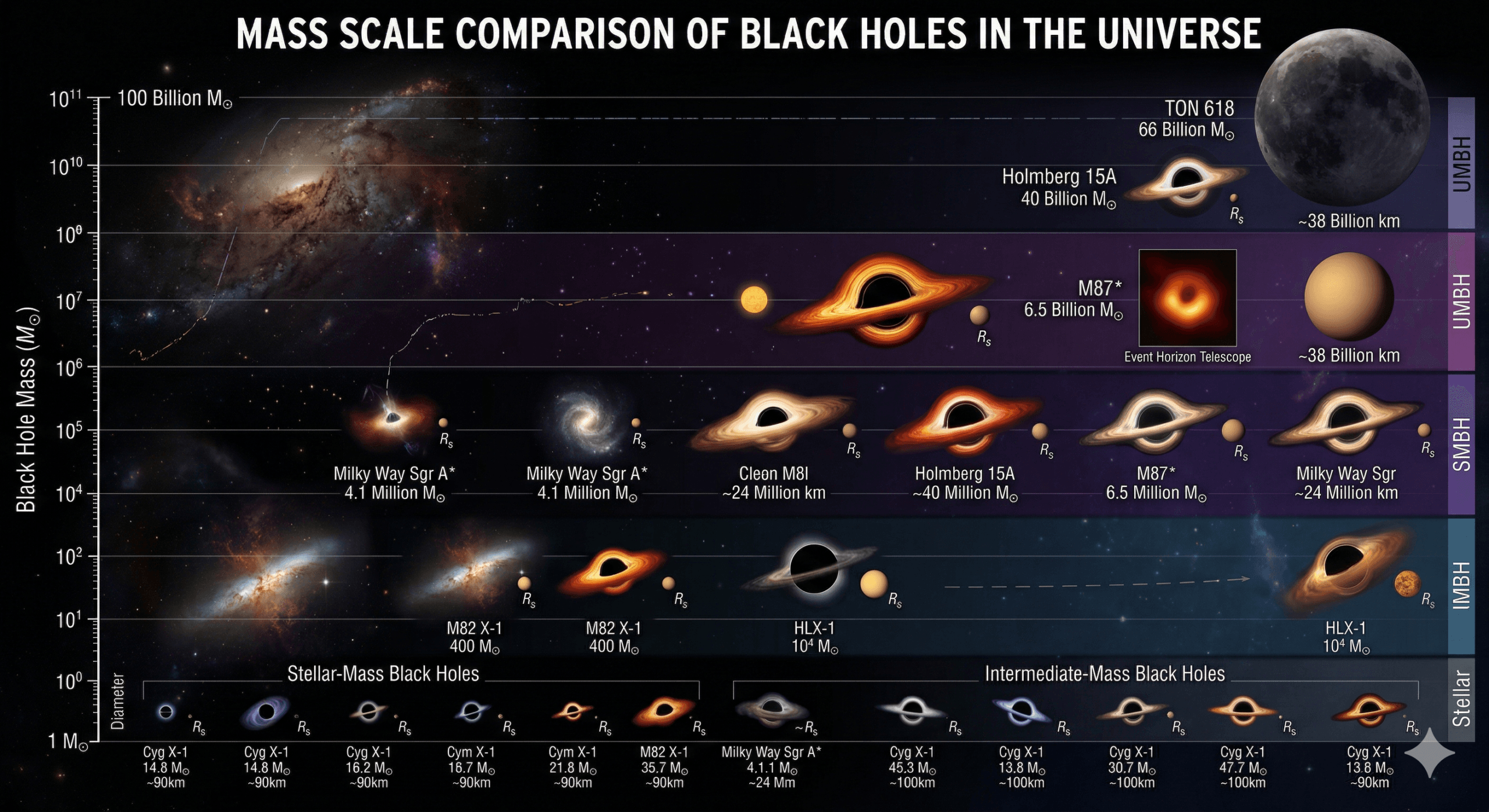
Because of these scaling laws, a stellar‑mass black hole has a lifetime vastly longer than the current age of the universe, while a tiny black hole with the mass of a mountain or an asteroid would evaporate much more quickly.
Intuitive analogy
An everyday analogy that shows Hawking radiation and black hole evaporation explained simply is to think of a red‑hot piece of metal cooling in air. A small piece of metal cools faster than a giant steel block because it has less heat energy to lose and usually a larger surface‑area‑to‑volume ratio. For black holes, the details are different, but the theme is similar: smaller black holes get hotter and radiate away their mass faster.
Discussions aimed at beginners sometimes point out that a shrinking black hole has less surface area but still emits more radiation; the resolution is that its temperature rises so much that the power per unit area increases dramatically. That is why in many scenarios the final second of a tiny black hole’s life could release as much energy as a huge explosion.
Lifetimes of Black Holes: Real Numbers That Blow Your Mind
To make Hawking radiation and black hole evaporation explained simply but concretely, it helps to look at orders of magnitude.
Evaporation time of a solar‑mass black hole
For a black hole with about the mass of the Sun, estimates show that the evaporation time is on the order of 10^64–10^67 years, depending on details and approximations – a number of years written as a 1 followed by roughly 64 zeros. One popular explanation notes that this is many, many orders of magnitude longer than the current age of the universe, which is only about 10^10 years.
More formal calculations using Hawking’s formula for the mass‑loss rate find that the lifetime of a black hole scales with the cube of its initial mass, leading to evaporation times of roughly 10^65 years for a solar‑mass black hole. A typical physics‑competition problem that asks “how long will it take a black hole to evaporate?” often quotes lifetimes around 1.4 × 10^65 years for a Sun‑mass black hole, illustrating how weak Hawking radiation is for large masses.
Hypothetical tiny black holes
In contrast, very small black holes – such as hypothetical primordial black holes formed in the early universe – could evaporate more quickly. For example, a black hole with the mass of a big mountain or an asteroid could have a lifetime comparable to or shorter than the current age of the universe, depending on its exact mass.
Some studies use Hawking radiation and black hole evaporation explained simply to constrain how many such primordial black holes could exist today without contradicting observations, because their evaporation would inject energy into the universe in observable ways. By comparing the predicted energy injection to data from cosmology, researchers carve out allowed and excluded mass ranges for primordial black holes as dark‑matter candidates.
Final explosive phase
As a black hole shrinks to very small sizes, its temperature and radiation power both increase drastically. Some models suggest that in the last fractions of a second, the black hole could release a burst of high‑energy particles and gamma rays, producing a flash that might resemble certain kinds of cosmic explosions.
This dramatic end stage turns Hawking radiation and black hole evaporation explained simply into a story with a surprising twist: what begins as an almost invisible trickle of radiation from a huge, cold black hole can end as a powerful and sudden burst from a tiny, extremely hot one.
Is Hawking Radiation Proven? What the Evidence Says
Theoretical status
From a theoretical point of view, Hawking radiation is a robust prediction that emerges whenever quantum fields are placed on a curved black‑hole spacetime. Multiple independent derivations, using different formalisms and models, reproduce the core result that black holes should emit thermal radiation with a specific temperature.
This theoretical consistency explains why physicists take Hawking radiation and black hole evaporation explained simply as a key part of modern black‑hole physics, even though direct observational confirmation is still missing for astrophysical black holes.
Direct observation challenges
The main difficulty lies in the weakness of the effect for large black holes. For stellar‑mass and supermassive black holes, the Hawking temperature is lower than the temperature of the cosmic microwave background, meaning their Hawking radiation is swamped by surrounding radiation. As a result, telescopes cannot easily separate a tiny Hawking signal from all the other light and particles in the environment.
However, recent theoretical work has argued that in certain extreme situations – such as the so‑called “black hole morsels” formed during mergers – Hawking radiation or related quantum signatures might be observable with current or near‑future telescopes sensitive to very high‑energy gamma rays. These proposals lay out search strategies based on correlations between merger events and delayed bursts of radiation.
Analog experiments and tentative hints
Physicists have also tried to observe Hawking‑like effects in laboratory analogues, such as fluid flows, optical fibres, and condensed‑matter systems that mimic horizons. Recent reports claim observation of stimulated Hawking radiation in artificial “black holes” created in high‑energy particle collisions and other setups, with data that fit theoretical expectations within statistical uncertainties.
These analogue and high‑energy experiments do not directly show Hawking radiation from astrophysical black holes, but they offer important clues that the underlying quantum‑field‑in‑curved‑spacetime picture is sound. In this sense, Hawking radiation and black hole evaporation explained simply are on firm theoretical ground and are beginning to receive experimental support in carefully designed systems.
Advanced Ideas: Primordial Black Holes and Dark Matter
Primordial black holes
Primordial black holes are hypothetical black holes that might have formed from density fluctuations in the very early universe, long before stars or galaxies existed. Depending on their initial mass, some primordial black holes could still be evaporating today, making Hawking radiation and black hole evaporation explained simply an important tool for cosmologists.
If primordial black holes were abundant in certain mass ranges, their evaporation would inject energy into the cosmic plasma, affecting nucleosynthesis, the cosmic microwave background, and the formation of structures. By comparing these predictions with observations, researchers use Hawking evaporation to rule out or constrain how many primordial black holes could exist.
Dark matter connection
In some models, primordial black holes represent a fraction or even all of the dark matter in the universe. Here, Hawking radiation and black hole evaporation explained simply play a double role: they provide both a signal that might reveal such black holes and a mechanism that could destroy them if they are too light.
New theoretical work shows that if Hawking evaporation breaks down or changes in the late stages, it could open “windows” in the allowed mass range where primordial black holes could survive as dark‑matter candidates. At the same time, improved analyses of evaporation and energy injection produce stronger constraints that close off other mass windows.
This ongoing back‑and‑forth highlights how a concept that started as an abstract prediction now influences real discussions about what makes up the invisible mass in the cosmos.
Common Myths About Hawking Radiation and Black Hole Evaporation
Because the topic is subtle, misconceptions are common. Here are a few corrected with Hawking radiation and black hole evaporation explained simply.
Myth 1: Hawking radiation comes from inside the event horizon
Many popular descriptions say that particles “escape” from inside the event horizon, but in the precise calculations, Hawking radiation is produced in the region outside the event horizon. Nothing, not even light, can escape from inside the horizon; the radiation is instead associated with quantum fields in the curved spacetime just outside it.
Myth 2: Hawking radiation has been clearly observed from astrophysical black holes
So far, there is no unambiguous detection of Hawking radiation from an astrophysical black hole. Instead, researchers have indirect evidence from analogue systems and are developing strategies to search for signals from tiny black holes or merger‑produced remnants.
Myth 3: All black holes are evaporating rapidly
In reality, Hawking radiation is incredibly weak for massive black holes, and their evaporation times are vastly longer than the current age of the universe. Large stellar‑mass and supermassive black holes are effectively stable on any human or galactic timescale, even though they technically lose mass through Hawking radiation.
Myth 4: The virtual‑particle picture is the full story
The virtual‑particle explanation is a useful teaching tool but does not capture the full complexity of the underlying quantum‑field calculation. Modern treatments emphasise wave modes, vacuum states, and the global structure of spacetime rather than literal particles forming exactly at the horizon.
Explaining Hawking Radiation and Black Hole Evaporation to Students
Teachers and communicators often want Hawking radiation and black hole evaporation explained simply but accurately for high‑school or early‑college students. A helpful approach is to build the explanation in layers.
Layer 1: Conceptual hook
Start by asking whether black holes can really live forever and whether anything can truly be perfectly black. This emotional hook sets up Hawking’s surprising answer: quantum effects make black holes glow and eventually evaporate.
Layer 2: Simple analogy
Use analogies: for instance, compare the black hole to a hot coal that appears dark but still emits infrared radiation and gradually cools. Explain that Hawking radiation and black hole evaporation explained simply mean black holes are more like very slow‑cooling objects than eternal traps.
Layer 3: Basic quantum idea
Introduce the idea that empty space is full of quantum fluctuations where particle pairs appear and disappear. Then, with a simple diagram, show how strong gravity near the event horizon can separate these pairs, with one particle falling in and the other escaping as radiation.
Layer 4: Honest caveats
Finally, tell students that this is a simplified picture; the real derivation uses advanced math, and physicists are still working to observe Hawking radiation directly. This balance between simplicity and honesty builds trust and curiosity.
Conclusion
Hawking radiation turned the conventional picture of black holes upside down by showing that quantum effects make them slowly emit energy and lose mass. When you see Hawking radiation and black hole evaporation explained simply, you discover that these supposedly eternal dark monsters are more like extremely slow‑burning embers that might eventually fade away.
While direct observations from astrophysical black holes remain elusive, theory strongly supports the existence of Hawking radiation, and new experiments and observational strategies are bringing us closer to testing it. At the same time, questions about evaporation, information, and dark matter ensure that black holes remain at the centre of some of the most exciting research in physics.
FAQs on Hawking Radiation and Black Hole Evaporation Explained Simply
1. What is Hawking radiation and black hole evaporation explained simply?
Hawking radiation and black hole evaporation explained simply mean that black holes slowly lose mass by emitting faint radiation due to quantum effects near their event horizon. Over incredibly long times, this radiation can make a black hole shrink and eventually disappear, a process called black hole evaporation.
2. Has Hawking radiation ever been observed directly?
Hawking radiation from astrophysical black holes has not yet been observed directly, mainly because the effect is so weak for large black holes. However, researchers are developing strategies to look for signals from tiny black holes and have seen Hawking‑like effects in laboratory analogue systems
3. How long does it take a black hole to evaporate?
The evaporation time depends strongly on the black hole’s mass and roughly scales as the mass cubed. For a black hole with the mass of the Sun, Hawking radiation and black hole evaporation, explained simply, point to lifetimes around 10^65 years, far longer than the current age of the universe.
4. Why do smaller black holes evaporate faster?
Smaller black holes are hotter because the Hawking temperature is inversely proportional to mass, so they emit more radiation per unit area. As they lose mass, they get even hotter, which accelerates the evaporation and can lead to a final explosive burst.
5. Is Hawking radiation related to dark matter?
Hawking radiation is used to test whether primordial black holes could make up some or all of dark matter, because their evaporation would inject energy into the universe in measurable ways. By comparing predictions with observations, scientists use Hawking radiation and black hole evaporation explained simply as tools to constrain these dark‑matter scenarios.
6. Does Hawking radiation mean information is lost?
Hawking’s original calculation suggested that black‑hole evaporation might destroy information, creating a deep puzzle known as the black‑hole information paradox. Many proposed resolutions now argue that information is preserved in some subtle way, but the full solution is still under debate.
7. Can black holes gain mass while they are evaporating?
Yes. In realistic environments, black holes can accrete gas, dust, and stars, gaining mass faster than they lose it through Hawking radiation. Hawking radiation and black hole evaporation explained simply mostly matter when accretion stops and when you consider extremely long timescales or very small black holes.
8. Where can I learn more about Hawking radiation and black hole evaporation explained simply?
You can explore popular‑science articles, university lecture notes, and review papers that cover Hawking radiation and black hole evaporation explained simply from multiple angles. Combining intuitive resources with more technical ones gives both a clear overview and a deeper understanding.