Introduction
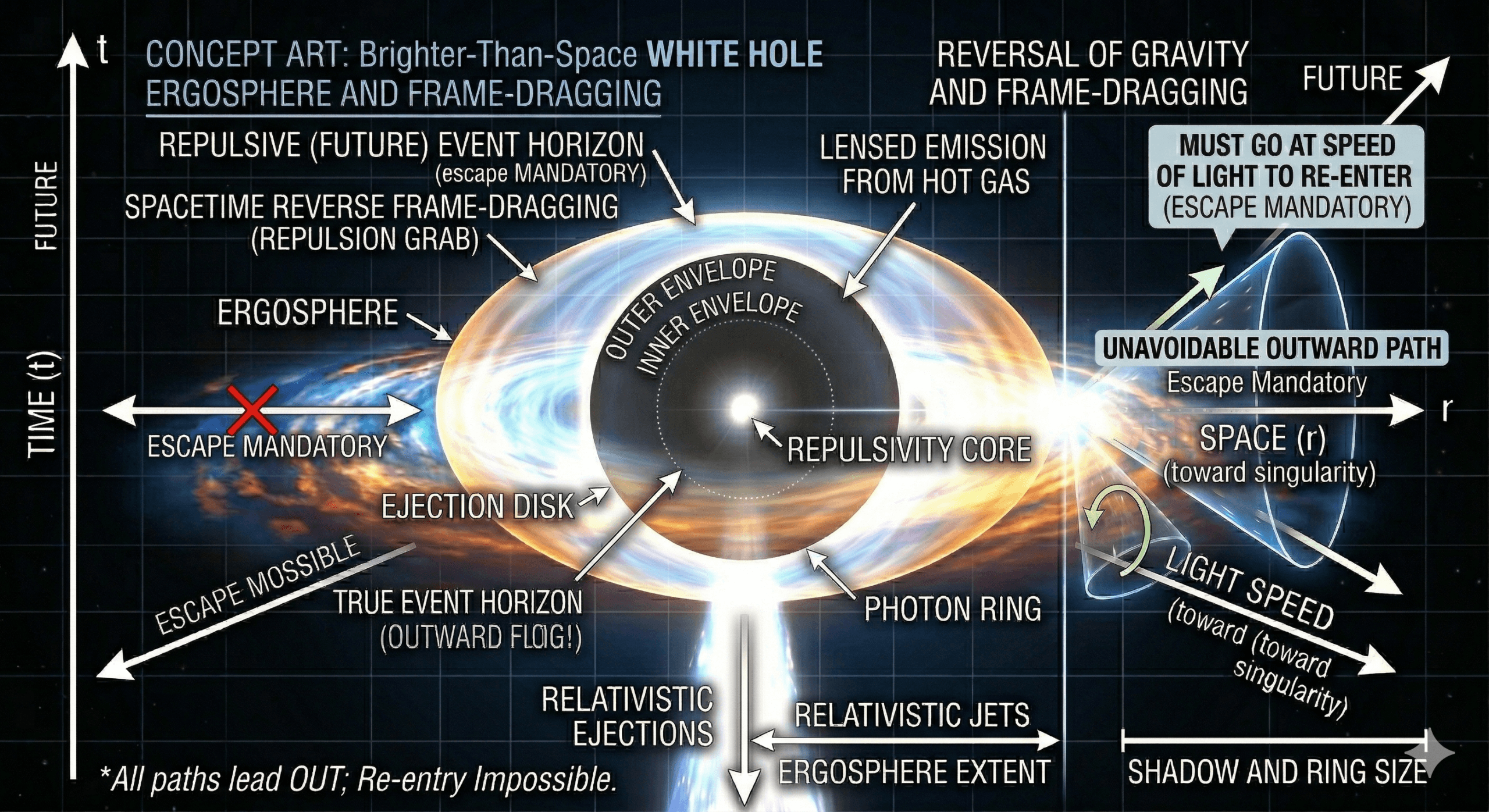
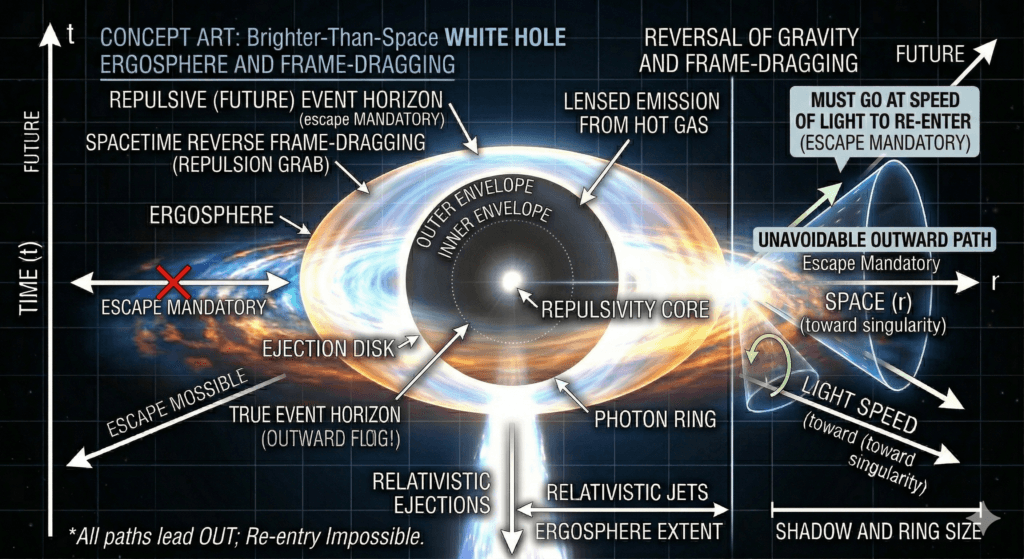
If you search for what is a white hole in space, you will quickly discover that it is not a normal astronomical object like a star or a galaxy; instead, it is a strange prediction that appears when physicists fully extend the mathematics of Einstein’s theory of gravity. In simple terms, a white hole is a hypothetical region of spacetime that continuously spits out matter and light but never allows anything to fall in.
Whereas black holes have become almost familiar—thanks to stunning images, gravitational‑wave detections, and decades of observations—white holes remain purely theoretical. They exist solidly on paper, in exact solutions and quantum‑gravity models, but so far, not in any telescope’s field of view.
In this long‑form guide, you will learn:
- Exactly what is a white hole in space and how it differs from a black hole.
- How white holes emerge from Einstein’s equations and from quantum‑gravity theories.
- Why many experts doubt that ideal white holes can ever form in the real universe.
- How white holes connect to wormholes, time‑travel myths, and the information‑loss paradox.
By the end, you will be able to explain what is a white hole in space to friends, students, or your own audience with confidence, without needing advanced mathematics.
Understanding What Is a White Hole in Space
At the most basic level, what is a white hole in space can be answered like this: it is a hypothetical region of spacetime from which matter and light can emerge but into which nothing can enter. In technical language, a white hole is the time‑reversed solution of a black hole in Einstein’s equations of general relativity.
A black hole has an event horizon that nothing can escape once it crosses from the outside; a white hole has an event horizon that nothing can cross from the outside to the inside. Anything inside a white hole is forced by the geometry of spacetime to move outward, so the object continuously ejects energy and matter instead of swallowing them.
Astrophysicists analyze white holes using the same mathematical framework used for black holes, but with the direction of time flipped. This time reversal makes the question of what is a white hole in space deeply linked to questions about the nature of time, entropy, and the ultimate fate of black holes themselves.
Simple Picture: A Black Hole in Reverse
A very intuitive way to understand what is a white hole in space is to imagine watching a video of a black hole and then playing it backwards. In the normal video, anything that comes too close to the black hole falls in forever and can never come back out.
In the reversed video, everything that once fell in now flies out, and nothing ever succeeds in entering. That reversed behaviour is exactly how a white hole behaves in the equations of general relativity.
The well‑known Schwarzschild solution, which describes a non‑rotating, uncharged black hole, can be extended to include both positive and negative time directions; this extended solution naturally contains a white‑hole region as well as a black‑hole region. In this ideal mathematical picture, the two regions are part of a larger spacetime that also includes a second universe connected through the horizons in something like a wormhole.
However, this elegant construction is a mathematical idealisation; realistic gravitational collapse of a star does not appear to produce the full eternal structure with both black‑ and white‑hole regions. That is one reason why many experts treat white holes as useful theoretical tools rather than as predictions of actual objects we should expect to see in the sky.
How White Holes Arise from Einstein’s Equations
White holes are not random inventions; they fall out naturally from the same Einstein field equations that predict black holes. When these equations are solved under the assumption that time is symmetric—meaning the laws look the same when time runs forward or backward—the solution includes both a black‑hole part and a white‑hole part.
Physically, a black‑hole region is defined as a part of spacetime from which no signal can reach distant observers, while a white‑hole region is a part that no signal from distant observers can ever enter. The boundaries of these regions are horizons, which are special null surfaces in spacetime, not physical membranes or solid shells.
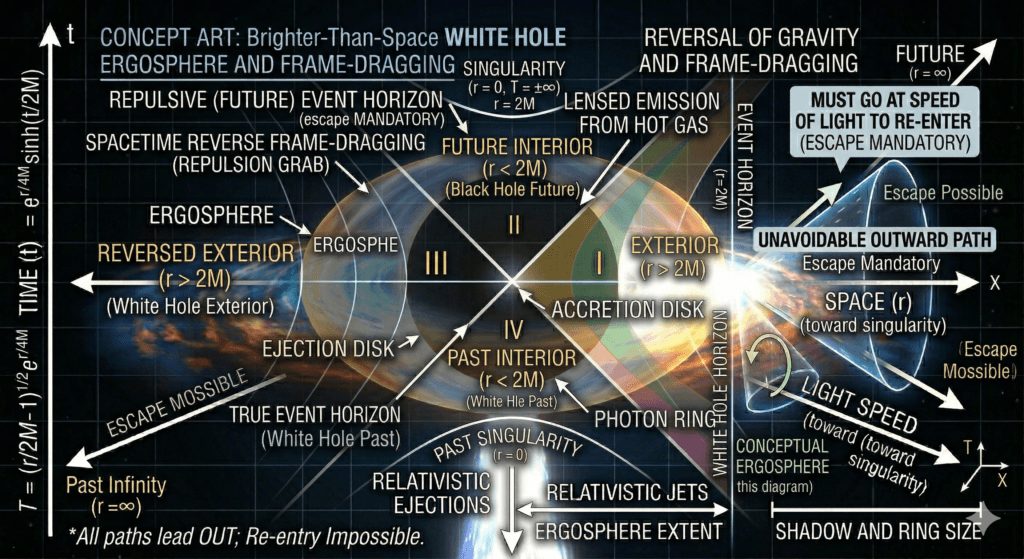
Kruskal–Szekeres coordinates are often used to visualise this full solution; in these coordinates, the white hole appears as a region where all allowed paths for light and matter point outward instead of inward. This construction shows that, at least mathematically, what is a white hole in space has a precise, rigorous definition grounded in general relativity, even if nature never realises that definition exactly.
White Hole vs Black Hole: Key Differences
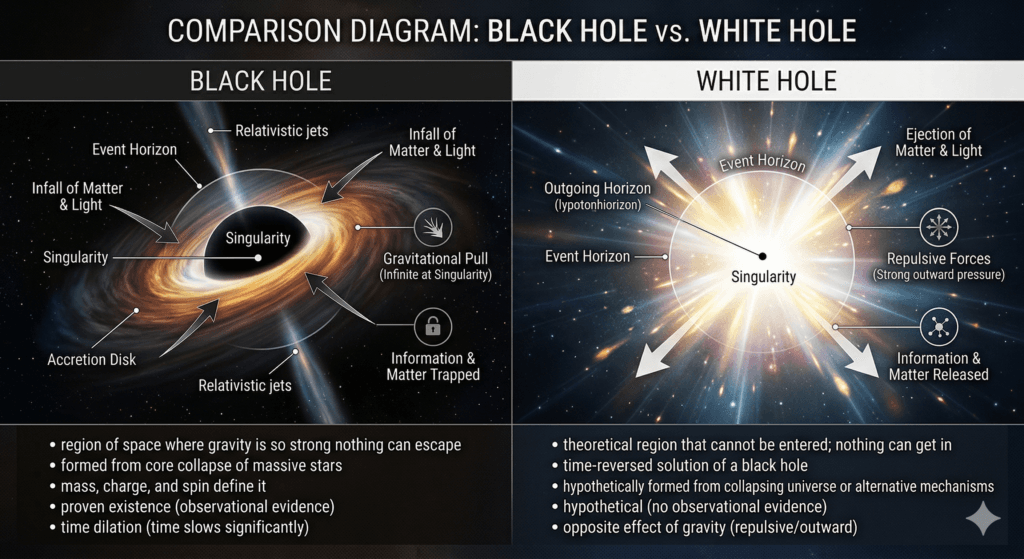
To make the idea of what is a white hole in space more concrete, it helps to compare it side by side with a black hole.
| Feature | Black Hole | White Hole |
|---|---|---|
| Basic role | Region that nothing can escape once it crosses the horizon | Region that nothing can enter from the outside |
| Time direction | “Forward” in the usual sense; matter falls in over time | Time‑reversed version of a black hole |
| Behaviour | Absorbs matter and light | Ejects matter and light |
| Evidence | Strong: X‑ray binaries, gravitational waves, black‑hole images | None so far; remains purely theoretical |
| Thermodynamics | Compatible with the second law of thermodynamics | Ideal eternal white holes appear to violate the second law |
Observationally, black holes are supported by multiple lines of evidence, including accretion‑disk X‑ray emissions, gravitational‑wave signals from mergers, and direct imaging of black‑hole shadows by the Event Horizon Telescope. In contrast, no telescope or detector has yet found an unambiguous signal that demands a white‑hole explanation.
Thermodynamics treats the two very differently as well: a classical eternal white hole that only emits and never absorbs matter would appear to decrease entropy in its surroundings, clashing with the second law of thermodynamics. This thermodynamic issue is one of the strongest arguments against the physical existence of perfectly ideal white holes as stable, long‑lived objects.
Do White Holes Really Exist? Current Evidence
Most researchers agree that what is a white hole in space is, at present, mainly a theoretical concept rather than a confirmed type of cosmic object. All strong evidence collected so far—across radio, optical, X‑ray, gamma‑ray, and gravitational‑wave observations—can be explained without invoking white holes.
Recent theoretical work, however, has revived interest in white‑hole‑like behaviour by suggesting that black holes might eventually transition into white holes at the end of their lives. In these models, quantum effects prevent the formation of a true singularity and instead cause a bounce, so that after an unimaginably long time the black hole re‑emerges as a white hole that expels much of the information it previously absorbed.
Some authors have speculated that certain unexplained transient events, such as short gamma‑ray bursts or unusual fast outbursts, might be signatures of such white‑hole‑like explosions, but these ideas remain highly speculative and are not accepted as standard explanations for those phenomena. The most cautious conclusion is that what is a white hole in space remains an attractive theoretical possibility with no direct observational support yet.
White Holes in General Relativity
Within classical general relativity, white holes appear as parts of exact, mathematically complete solutions to Einstein’s equations, such as the maximally extended Schwarzschild spacetime. This spacetime contains four distinct regions: an external universe, a black‑hole region, a white‑hole region, and a second external universe connected via the horizons.
The white‑hole region is “in the past” of the external universe in a precise causal sense: signals can come from the white hole into the external region, but nothing in the external region can send a signal back into the white hole. In this framework, when one asks what is a white hole in space, the answer is purely geometric: it is a region whose causal structure forbids any in‑going signals from the outside.
However, realistic astrophysical processes, such as the collapse of a massive star, do not seem to produce such white‑hole regions. Numerical simulations and analytic arguments show that collapse leads to a black hole, not to the fully symmetric eternal spacetime that includes a white hole, and the white‑hole part is often viewed as an artifact of extending the solution beyond what any real collapse can generate.
For that reason, many relativists treat white holes in pure general relativity as formal features of idealised solutions instead of literal predictions of cosmic objects that must exist somewhere in the universe.
Quantum Gravity Ideas: From Black Hole to White Hole
Some of the most creative ideas about what is a white hole in space come from quantum gravity—the attempt to merge quantum mechanics with general relativity at extremely high energies and densities. In several approaches, quantum effects can prevent the formation of a classical singularity and instead cause a bounce or phase change in the geometry inside a black hole.
Loop quantum gravity models, for example, have explored scenarios in which the interior of a black hole undergoes a quantum bounce and then emerges as a white hole. In these models, the region that would classically be singular is replaced by a finite “quantum region,” and on the far side of that region spacetime resembles a white hole that emits the matter that once fell in.
More recent analyses have shown that maintaining a consistent causal structure and generalised covariance places strong constraints on black‑to‑white‑hole transition models and rules out some earlier, simpler constructions. Other theoretical work, using ideas like thin‑shell wormholes or modified gravity, has studied whether a black‑hole region and a white‑hole region could be surgically connected without singularities.
Although none of these quantum‑gravity scenarios have led to clear, unique observational predictions yet, they keep the concept of what is a white hole in space actively alive in cutting‑edge theoretical research.
White Holes, Wormholes, and Time‑Travel Myths
Because white holes appear alongside wormhole‑like structures in some idealised solutions, they are often linked in popular media to faster‑than‑light travel and time machines. In the maximally extended Schwarzschild diagram, the black‑hole and white‑hole regions sit between two universes, forming what looks like a tunnel or Einstein–Rosen bridge connecting them.
This has inspired many descriptions in which a traveller enters a black hole in one universe and exits from a white hole in another, raising the tempting question of whether what is a white hole in space could be an inter‑universe gateway. However, a more careful analysis shows that the classical Schwarzschild wormhole is unstable and pinches off too quickly for any material object—or even light—to traverse it.
On top of that, energy‑condition arguments and considerations from thermodynamics and quantum field theory suggest that maintaining a traversable wormhole attached to a white hole would require exotic matter and likely conflict with the second law of thermodynamics. For these reasons, mainstream physicists treat wormhole‑plus‑white‑hole time‑travel scenarios as interesting thought experiments rather than realistic possibilities.
Possible Observational Signatures of White Holes
If what is a white hole in space describes something that really occurs in nature, then there should be at least some indirect signatures where white‑hole physics leaves a trace. Several research groups have tried to identify what those traces might look like.
One possibility is that a black‑to‑white‑hole transition would create a violent burst of gravitational waves with a distinctive frequency spectrum as the spacetime geometry rapidly changes. Theoretical work suggests that current and future networks of gravitational‑wave detectors, operating over low and mid‑frequency bands, might be able to detect such bursts if they occur often enough and are strong enough.
Another idea is that a small white‑hole‑like object would appear as a brief, bright outburst of high‑energy radiation, perhaps resembling some classes of gamma‑ray bursts or fast transients, though current observations do not require such an explanation. A few speculative models even propose that tiny primordial white holes produced in the early universe could contribute to dark matter, but these proposals remain controversial and far from established.
So far, no candidate event has been widely accepted as evidence of a white hole, so what is a white hole in space remains an open and challenging question from an observational point of view.
Real‑World Analogies and Thought Experiments
White holes are so counter‑intuitive that analogies are very useful when explaining what is a white hole in space to non‑experts. One common analogy compares a black hole to a one‑way drain in a sink: beyond a certain point, water can only flow inward, while a white hole would be like a powerful fountain that only throws water outward and never lets anything fall in.
Another thought experiment imagines recording the entire process of matter falling into a black hole and then playing the recording backwards; everything once swallowed now flies outward, and the surface that acted as a one‑way entrance now works as a one‑way exit. This time‑reversed movie captures the essence of what is a white hole in space without requiring advanced mathematics.
These analogies are, of course, simplified; they ignore issues such as Hawking radiation, entropy, and the detailed stability of horizons. Still, they help build intuition and make later technical explanations much easier to follow.
Explaining to Students What Is a White Hole in Space
Teachers, tutors, and content creators often need to explain what is a white hole in space to high‑school or undergraduate students without overwhelming them. A practical strategy is to begin with black holes, which students may already know from images and movies, and then introduce white holes as the mathematically allowed but probably unreal mirror images of those objects.
Visual aids can make a huge difference here. Simple spacetime diagrams, animations, or whiteboard sketches with arrows pointing inward for black holes and outward for white holes help students see the one‑way nature of each horizon. It also helps to emphasise that, although what is a white hole in space sounds dramatic, current evidence suggests that such objects are speculative and still under active debate among physicists.
For more advanced students, white holes provide an excellent entry point into deeper topics such as event horizons, Penrose diagrams, Hawking radiation, the information‑loss paradox, and quantum‑gravity models of black‑hole interiors. In this way, a simple question can lead to a rich exploration of modern gravitational physics.
Conclusion and Next Steps
White holes emerge naturally when Einstein’s equations are extended in a time‑symmetric way, giving a clear but surprising answer to what is a white hole in space: it is the time‑reversed twin of a black hole that only emits and never absorbs. Once realistic collapse, thermodynamics, and quantum effects are taken into account, however, the case for real white holes in our universe becomes much weaker, and no direct observational evidence has been found so far.
At the same time, cutting‑edge quantum‑gravity research keeps the idea alive by studying black‑to‑white‑hole transitions, singularity resolution, and possible observational signals such as unusual gravitational‑wave bursts. For students, teachers, and science communicators, this blend of solid mathematics, deep conceptual puzzles, and open questions makes what is a white hole in space a powerful topic for sparking curiosity about gravity, quantum theory, and the evolving picture of the cosmos.
1. What is a white hole in space in simple terms?
In everyday language, what is a white hole in space can be described as the theoretical opposite of a black hole: a region that only lets matter and light out and never lets anything in. Mathematically, it is obtained by reversing the direction of time in the equations that describe a black hole.
2. Do white holes actually exist in the universe?
Right now, there is no direct observational evidence that white holes exist anywhere in the cosmos. They are predicted by certain exact solutions of general relativity and by some quantum‑gravity models, but most astrophysicists see them as speculative rather than established
3. How is a white hole different from a black hole?
A black hole is a region from which nothing, not even light, can escape once it crosses the event horizon, whereas what is a white hole in space describes a region that nothing can enter from the outside. Black holes absorb matter and can be observed indirectly through their strong gravitational effects, while white holes would continuously emit matter and light and have not yet been detected.
4. Can a black hole turn into a white hole?
Some quantum‑gravity theories propose that a black hole might undergo a slow transition into a white hole after a very long time, releasing the information it once stored. These black‑to‑white‑hole transition models are mathematically consistent in certain frameworks and could help resolve the information‑loss paradox, but they remain untested in observations.
5. Could a white hole create a new universe?
A few speculative ideas suggest that what is a white hole in space could act as a “birth point” for a new region of spacetime, sometimes described as a baby universe. These scenarios rely on assumptions about quantum gravity that have not yet been experimentally verified, so they should be viewed as imaginative possibilities rather than established facts.
6. Are white holes related to wormholes or time travel?
In the maximally extended Schwarzschild solution, the white‑hole region appears together with a wormhole‑like connection between two universes, which has inspired many stories about time travel and inter‑universe journeys. In reality, the classical wormhole in this solution is unstable and pinches off too quickly for any object to pass through, so realistic time‑travel schemes based on white holes are not supported by current physics.
7. Why do some physicists say white holes violate the second law of thermodynamics?
An ideal, eternal white hole that only emits matter and radiation and never absorbs anything would reduce the total entropy of its surroundings, apparently violating the second law of thermodynamics. This thermodynamic argument is a key reason many experts doubt that the simplest versions of what is a white hole in space can exist as stable, isolated objects in our universe
8. Where can I learn more about what is a white hole in space?
To explore what is a white hole in space in greater depth, you can combine readable popular‑science articles, technical research papers on black‑to‑white‑hole transitions, and university lecture notes on general relativity and black‑hole thermodynamics. Together, these sources provide both intuitive explanations and rigorous mathematical detail.