
If you have ever stared at a night sky and wondered how black holes really work, you are not alone. These invisible giants have gravity so strong that not even light can escape, yet we now have real photographs, precise mass measurements, and even movies of stars orbiting around them.
In this ultimate guide, we will break down how black holes really work in simple, human language—no PhD required. You will learn what happens at the event horizon, how singularities form, how black holes grow, and what the first image of a black hole actually shows.
Table of Contents
- Secret 1: What a Black Hole Really Is
- Secret 2: The Anatomy of a Black Hole
- Event Horizon: Point of No Return
- Singularity: Gravity’s Final Boss
- Accretion Disk and Relativistic Jets
- Secret 3: How Black Holes Form and Grow
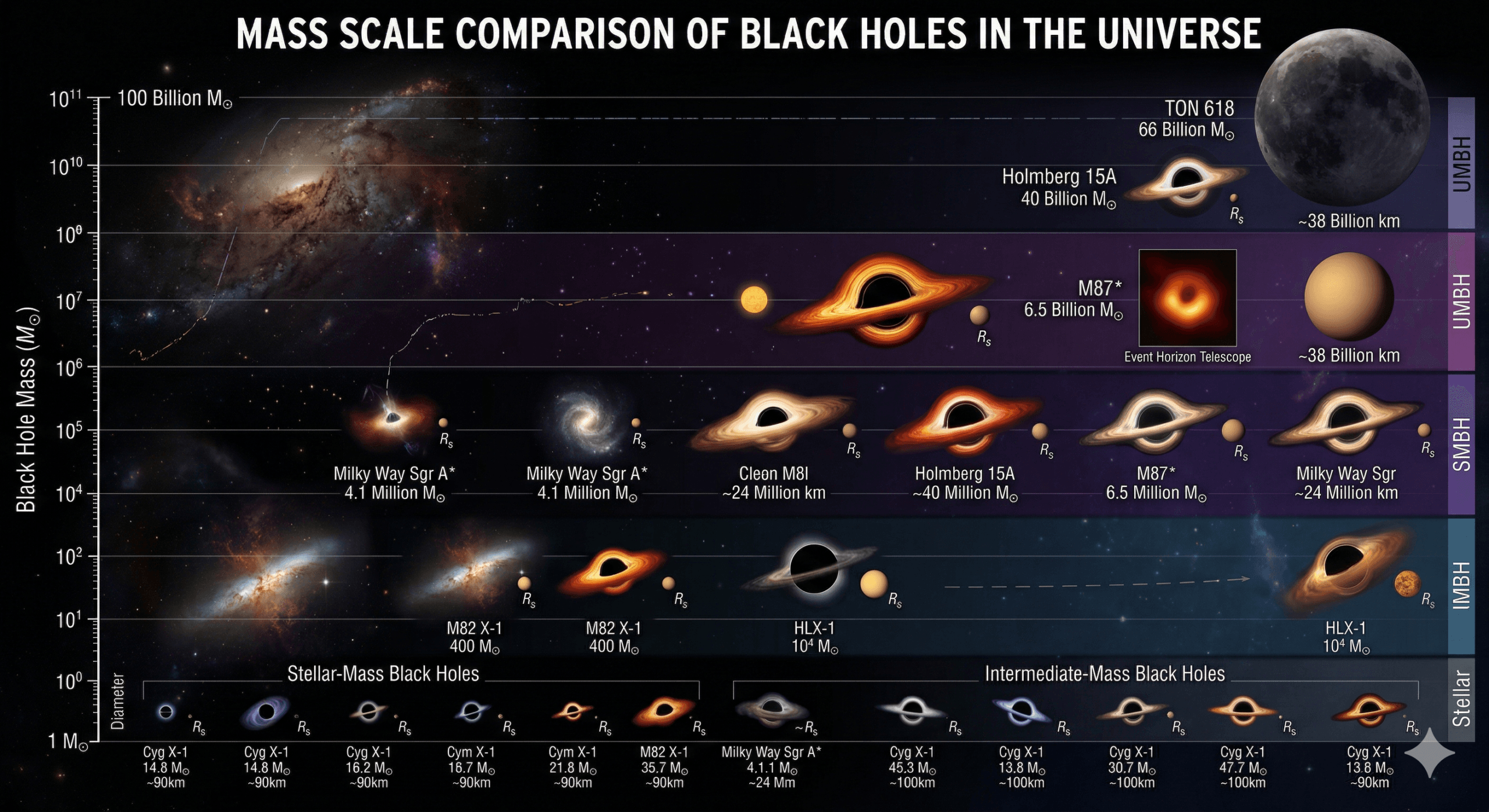
- Stellar‑Mass Black Holes
- Supermassive Black Holes
- Secret 4: How Black Holes Really Work on Spacetime
- General Relativity in Plain English
- Time Dilation Near a Black Hole
- Secret 5: Real Case Studies – M87* and Sagittarius A*
- M87*: The First Black Hole Image
- Sagittarius A*: Our Galactic Black Hole
- Secret 6: What Happens If You Fall In?
- Secret 7: How We Study How Black Holes Really Work
- FAQ: How Black Holes Really Work
- Conclusion
Secret 1: What a Black Hole Really Is
To understand how black holes really work, start with the simplest definition: a black hole is an object so compact that its gravity prevents anything—even light—from escaping once it gets too close. Albert Einstein’s general relativity predicts that if you squeeze enough mass into a small enough volume, spacetime curves so much that escape becomes impossible.
The boundary where escape becomes impossible is called the event horizon. Outside this boundary, gravity is extremely strong but not unbeatable; inside it, every possible path leads inward, and no signal can make it back out to the rest of the universe. When people ask how black holes really work, they are usually asking what happens at and inside this mysterious horizon.
Secret 2: The Anatomy of a Black Hole
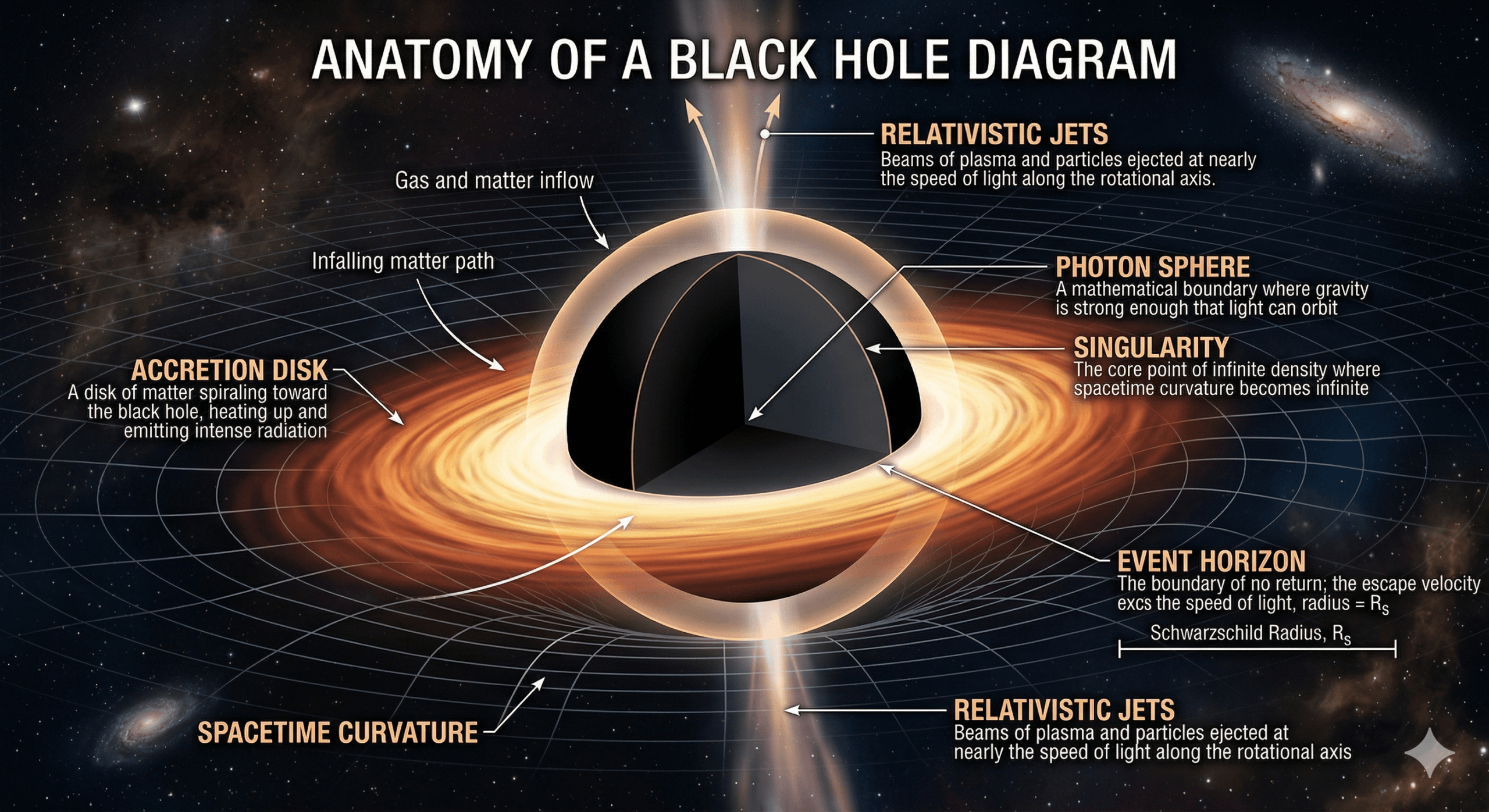
A beautiful way to see how black holes really work is to break them down into their main parts. Despite huge differences in size, most black holes share the same basic structure.
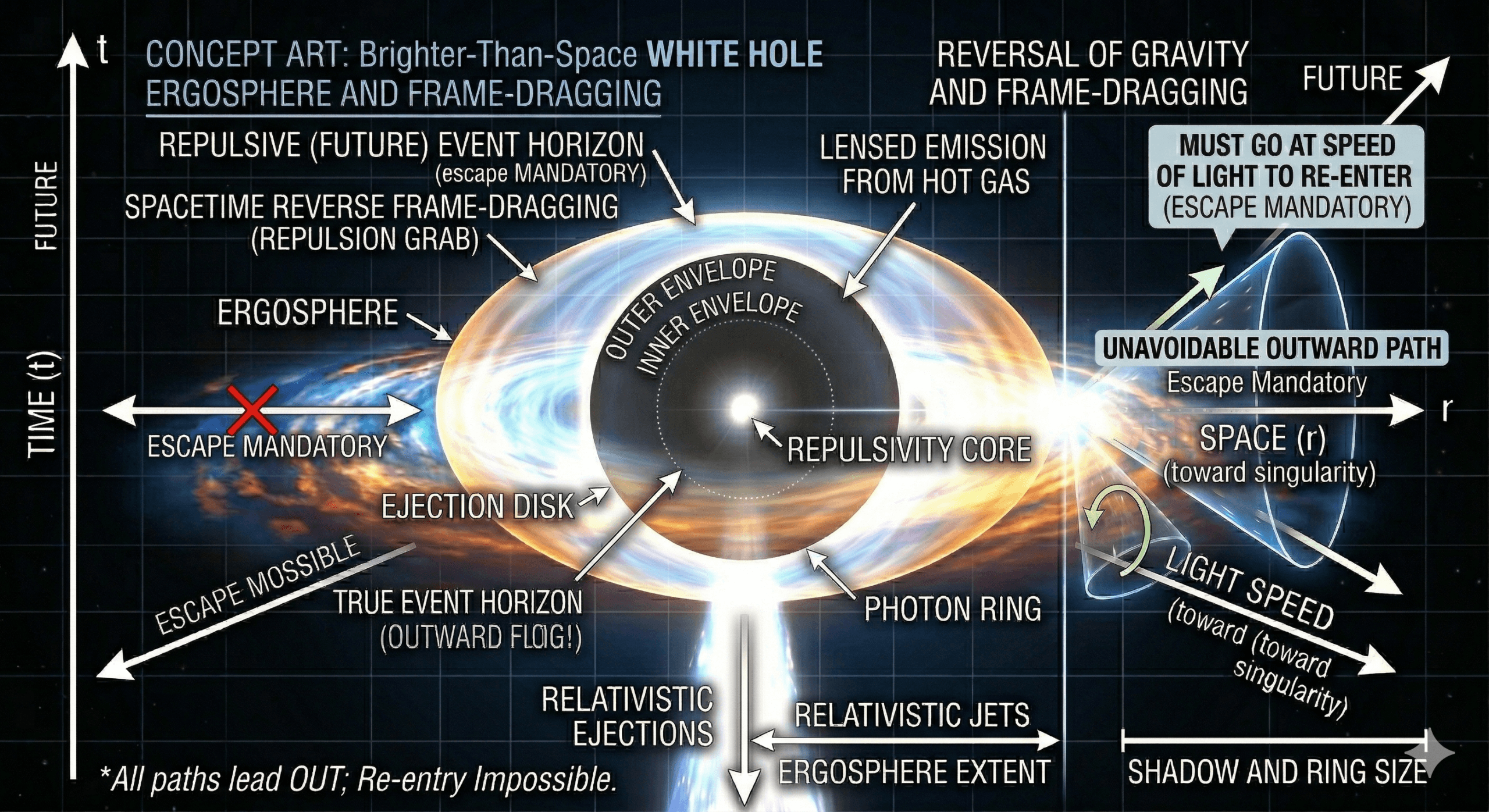
Event Horizon: Point of No Return
The event horizon is the outer “surface” of a black hole. It is not a solid wall but a spherical boundary in spacetime:
- At the event horizon, the escape velocity equals the speed of light.
- Outside, light and matter can still escape if they move fast enough or in the right direction.
- Inside, all paths through spacetime lead inevitably inward; nothing can get out.
This is one of the most important parts of how black holes really work: the event horizon sets the limit of what the outside universe can ever see or know about what happens inside.
Singularity: Gravity’s Final Boss
At the very center lies the singularity, a point (or ring, for rotating black holes) where, according to our current mathematics, density and spacetime curvature become infinite.
- All the mass of the black hole is effectively concentrated at or near this point.
- The known laws of physics break down; general relativity predicts the singularity, but quantum mechanics has not yet been fully combined with gravity.
Physicists suspect that a future “quantum gravity” theory will explain how black holes really work at the singularity, but for now, we know only that our existing equations fail there.
Accretion Disk and Relativistic Jets
Real astronomical black holes are rarely “naked.” They often sit surrounded by swirling accretion disks of hot gas and dust plus, in some cases, powerful relativistic jets.
- Gas spirals inward, forming a bright disk that can shine across the electromagnetic spectrum.
- Magnetic fields and rotation can launch jets of particles moving close to the speed of light, as seen in the galaxy M87 where the jet extends roughly 3,000 light‑years.
These glowing disks and jets are how we indirectly “see” black holes and how astronomers test models of how black holes really work in practice.
Secret 3: How Black Holes Form and Grow
Another key to understanding how black holes really work is knowing how they are born and how they gain mass over time. Astronomers distinguish between stellar‑mass and supermassive black holes, plus some more exotic possibilities.
Stellar‑Mass Black Holes
Stellar‑mass black holes form when very massive stars reach the end of their lives.
- Stars heavier than roughly 8–10 times the Sun’s mass can end as black holes instead of white dwarfs or neutron stars.
- When such a star runs out of nuclear fuel, its core collapses under its own gravity.
- If the mass is large enough, not even neutron degeneracy pressure can support it, and the core collapses into a black hole.
Sometimes the star explodes in a supernova and the leftover core becomes a black hole; in other cases, the collapse may be so direct that there is little or no bright explosion. Either way, this is the basic route by which nature first sets up how black holes really work in stellar systems.
Supermassive Black Holes
At the centers of most large galaxies, including our Milky Way, lurk supermassive black holes with millions to billions of times the Sun’s mass.
How do they form?
- One path: they start as stellar‑mass black holes that grow by swallowing gas, stars, and other black holes over billions of years.
- Another: direct collapse of giant gas clouds in the early universe, forming “seed” black holes of 10,000–100,000 solar masses that then grow.
- Mergers of many smaller black holes during galaxy collisions also contribute.
Today, there is strong evidence that supermassive black holes exist in the centers of most galaxies, shaping galaxy evolution through their gravity and energetic feedback. Studying these giants is a powerful way to see how black holes really work on cosmic scales.
Secret 4: How Black Holes Really Work on Spacetime
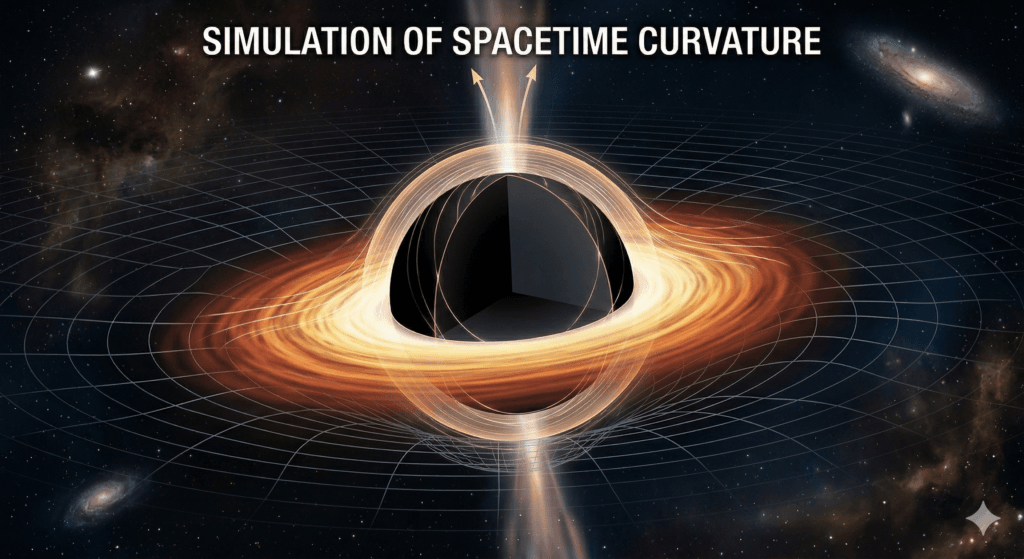
Black holes are not just “objects” sitting in space—they are regions where spacetime itself is curved to an extreme. To grasp how black holes really work, you need a basic feel for Einstein’s general relativity.
General Relativity in Plain English
General relativity says that:
- Mass and energy tell spacetime how to curve.
- Curved spacetime tells matter and light how to move.
Near a black hole, this curvature becomes so intense that all possible paths inside the event horizon lead toward the center. Light follows the straightest possible path in curved spacetime, but those “straight” paths now bend inward and never emerge.
So when we talk about how black holes really work, we are really describing how spacetime itself wraps around them, not just how matter behaves inside a fixed background.
Time Dilation Near a Black Hole
General relativity also predicts that time flows differently near strong gravity. This is a dramatic piece of how black holes really work:
- For a distant observer, a clock near the event horizon appears to tick more slowly—this is gravitational time dilation.
- An object falling toward the horizon appears to slow down and “freeze” as it approaches, its light increasingly red‑shifted and dim.
- For the falling object itself, time feels normal; it crosses the horizon in a finite time and experiences no sharp wall there.
This difference between outside and inside viewpoints is central to both the physics and the paradoxes of how black holes really work.
Secret 5: Real Case Studies – M87* and Sagittarius A*
Black holes were once purely theoretical, but now we have direct images and high‑precision measurements. These real examples show how black holes really work in the universe.
M87*: The First Black Hole Image
In 2019, the Event Horizon Telescope (EHT) collaboration released the first image of a black hole, a supermassive black hole called M87* at the center of the galaxy Messier 87, about 55 million light‑years away.
- The image shows a bright ring of emission around a dark “shadow,” which matches predictions from general relativity for a spinning black hole with an event horizon.
- M87* powers a relativistic jet visible over about 3,000 light‑years, observed across the electromagnetic spectrum.
- By comparing the image with simulations, scientists confirmed a rotating supermassive black hole and learned more about how jets extract energy from its spin.
This historic result is one of the clearest demonstrations of how black holes really work—we can literally map the region around an event horizon and see light bent into a ring by extreme gravity.
Sagittarius A*: Our Galactic Black Hole
At the center of the Milky Way lies Sagittarius A* (Sgr A*), a compact radio source now confirmed to be our galaxy’s own supermassive black hole.
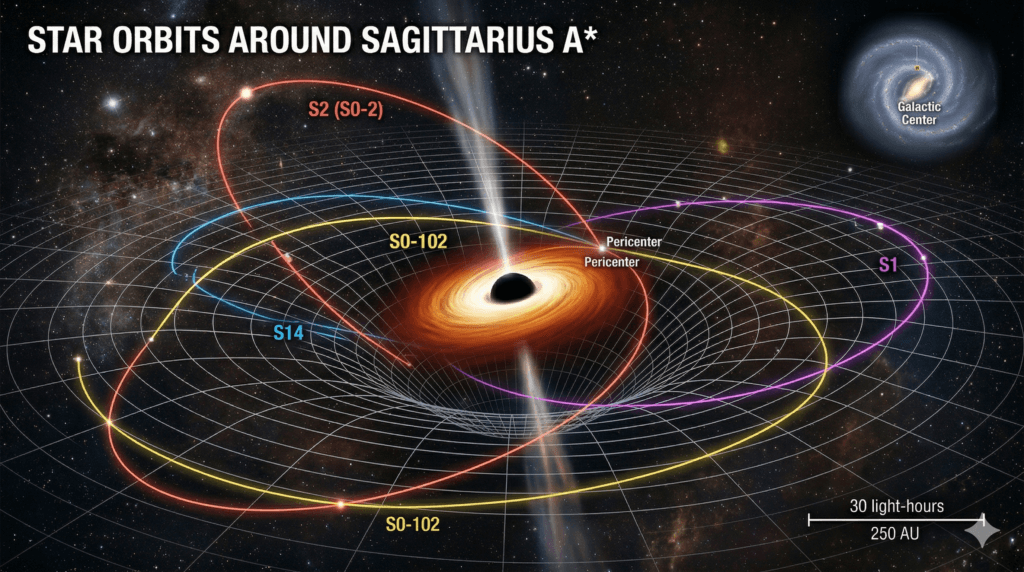
- Careful tracking of stars, especially one called S2, orbiting very close to Sgr A* shows that the central mass is about 4.3 million times the mass of the Sun.
- The volume of space that contains this mass is so small that no known object other than a black hole fits the data.
- Observations of S2’s orbit have provided tests of general relativity, such as gravitational redshift and orbital precession, in a strong‑gravity environment.
More recently, the EHT has produced images of Sgr A* as well, offering another laboratory for studying how black holes really work up close.
Secret 6: What Happens If You Fall In?
One of the most popular questions about how black holes really work is: what happens if something falls in—say, a star, a spaceship, or an unlucky astronaut?
From far away:
- The object appears to slow down as it approaches the event horizon, its light red‑shifted and dimmer over time.
- To a distant observer, it never quite crosses the horizon; it just fades away.
From the falling object’s own point of view:
- It crosses the event horizon in finite time without noticing a sharp boundary at that point.
- As it moves inward, tidal forces—differences in gravity between its near and far sides—increase. In many black holes, especially small ones, these forces would eventually stretch and compress the object in a process nicknamed “spaghettification.”
The exact interior structure of a realistic black hole is still an open research area, especially because quantum effects and possible “shock singularities” may alter what happens near inner horizons in rotating black holes. But at the classical level, this is the best‑understood picture of how black holes really work on infalling matter.
Secret 7: How We Study How Black Holes Really Work
Given that we cannot send probes inside event horizons, how do scientists actually learn how black holes really work? They use several powerful tools.
1. Watching Stars Orbit
By tracking the orbits of stars around invisible central masses, astronomers can measure black hole masses and test gravity:
- The S‑star cluster around Sagittarius A* has been observed for decades; star S2’s 16‑year orbit provided precise mass estimates and tests of general relativity.
- Similar techniques in other galaxies reveal supermassive black holes through the motions of gas and stars near their centers.
2. Imaging with the Event Horizon Telescope
The EHT links radio telescopes across the world to act like a telescope the size of Earth, letting us image structures on event‑horizon scales.
- By resolving the bright ring and shadow of M87*, the EHT confirmed the predicted appearance of a spinning black hole.
- Future EHT observations and upgrades will sharpen these images and map magnetic fields and accretion flows, revealing more about how black holes really work in detail.
3. Detecting Gravitational Waves
Gravitational‑wave observatories like LIGO and Virgo detect ripples in spacetime produced when black holes merge.
- These waves carry information about the black holes’ masses, spins, and the dynamics of their merger.
- Comparing observed waveforms with simulations tests general relativity in the strongest gravity we can measure.
4. Simulations and Theory
Supercomputer simulations solve Einstein’s equations and plasma physics equations around black holes to predict:
- How accretion disks behave.
- How jets are launched.
- How the shadow should look in different wavelengths.
By comparing these predictions to observations, scientists refine their understanding of how black holes really work and where current theories fall short.
Conclusion
Black holes used to be pure science fiction, but now we can watch stars orbit Sagittarius A*, see the shadow of M87*, and measure gravitational waves from colliding black holes—all powerful clues to how black holes really work. From stellar‑mass remnants of massive stars to supermassive monsters driving galaxy evolution, black holes sit at the frontier of gravity, quantum physics, and cosmology.
1. What is a black hole in simple words?
A black hole is a region of space where so much mass is packed into such a small volume that its gravity traps everything, even light. This “no‑escape” region is the core idea behind how black holes really work.
2. How black holes really work at the event horizon?
At the event horizon, the escape speed equals the speed of light. Outside the horizon, light and matter can still get away; inside, all paths lead inward. This one‑way boundary is crucial to how black holes really work, because it blocks any information from leaving the interior.
3. How do black holes form from stars?
When very massive stars—roughly more than 8–10 times the Sun’s mass—run out of fuel, their cores can collapse under gravity. If no known pressure can stop the collapse, a black hole forms. This stellar‑mass origin is the first step in how black holes really work in many galaxies.
4. Are there black holes at the center of galaxies?
Yes. There is strong evidence that most large galaxies host supermassive black holes at their centers, including Sagittarius A* in the Milky Way with about 4.3 million solar masses. These giants shape how black holes really work on galactic scales, influencing star formation and gas flows.
5. What did the first photo of a black hole show?
The Event Horizon Telescope’s first image of M87* showed a bright ring of emission surrounding a dark shadow, exactly as predicted for a spinning black hole with an event horizon. That ring is light bent by extreme gravity, giving us a direct look at how black holes really work near the horizon.
6. What happens if you fall into a black hole?
From far away, you seem to slow down and fade as you approach the event horizon. From your own viewpoint, you cross the horizon without noticing a sharp edge, then experience growing tidal forces that can stretch and compress you—“spaghettification”—as you move inward. This dramatic fate is part of how black holes really work on matter.
7. Can black holes evaporate?
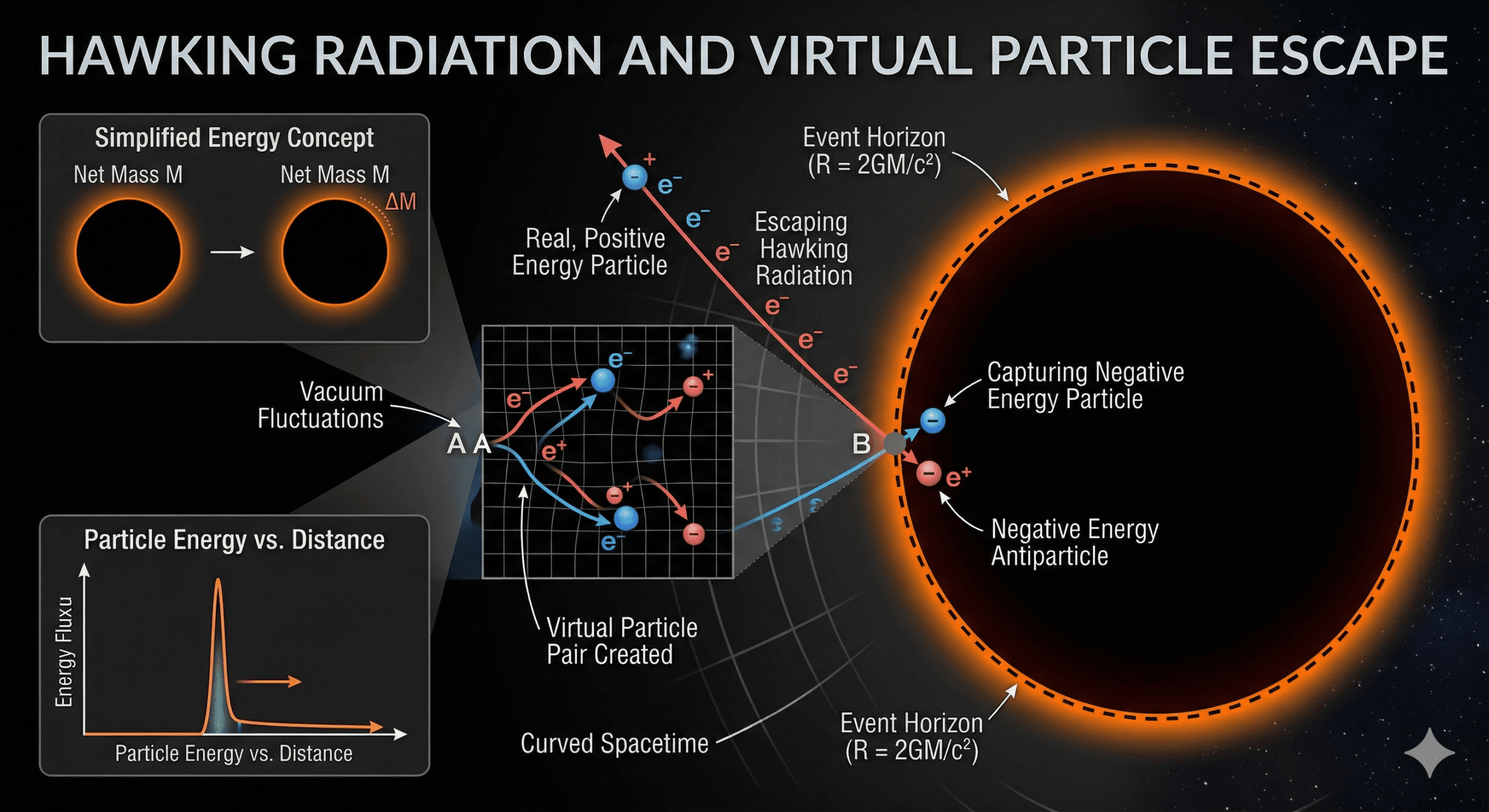
Quantum theory predicts that black holes slowly emit Hawking radiation, losing mass over incredibly long timescales. For stellar and supermassive black holes, this evaporation is far slower than the age of the universe, but it is an important theoretical piece of how black holes really work in the long run.
8. How do scientists study how black holes really work if we can’t see inside?
Astronomers study how black holes really work by observing stars orbiting them, imaging gas near the event horizon, detecting gravitational waves from black‑hole mergers, and comparing these observations to supercomputer simulations. These indirect methods reveal the physics without crossing the horizon.


4 thoughts on “7 Mind‑Blowing Secrets: How Black Holes Really Work”