Iran’s missile arsenal has become one of the most talked‑about military topics in the world, yet most people only know a few names like Shahab or Sejjil and not how the full system fits together. In this guide, you’ll get a clear, non‑technical explanation of the Iran missile arsenal, including its history, main missile families, ranges, strategy, and recent developments, using simple language but serious research.
New Systems: Kheibar Shekan, Fattah, and Hypersonic Claims
Range and Accuracy: How Far Can Iran’s Missiles Go?
Who Controls the Iran Missile Arsenal?
Case Studies: How Iran Has Used Missiles in Real Conflicts
Regional and Global Reactions to Iran’s Missile Arsenal
Future Trends in Iran’s Missile Development
FAQ About Iran’s Missiles
Conclusion
What Is the Iran Missile Arsenal?
When analysts talk about theIran missile arsenal, they usually mean Iran’s full collection of short‑range, medium‑range, cruise, and possibly hypersonic missiles, plus related launchers and support systems. Independent research institutes and Western intelligence assessments agree that Iran now has the largest and most diverse missile arsenal in the Middle East, with hundreds of launchers and well over a thousand operational missiles.
These missiles include older liquid‑fuel designs inspired by Soviet Scud technology and newer solid‑fuel systems that are easier to deploy, hide, and launch quickly. The Iran missile arsenal also covers land‑attack ballistic missiles, anti‑ship missiles aimed at naval targets, cruise missiles that fly low and slow, and space‑launch rockets that share technologies with long‑range missiles.
Why Iran Built a Large Missile Arsenal
Iran did not start out as a missile power; its interest in missiles grew out of military weakness and wartime experience. During the 1980–88 Iran–Iraq War, Iraq used Scud missiles to hit Iranian cities, while Iran had almost no modern air force or long‑range strike tools to respond, creating a strong motivation to develop or buy missiles of its own.
Over the following decades, international sanctions and export controls made it hard for Iran to buy modern fighter jets or advanced airpower, so missiles became a relatively cheap, reliable way to project power and deter enemies like the United States, Israel, and Saudi Arabia. Iranian doctrine today treats missiles as a central pillar of deterrence, promising punishment against bases and cities if Iran itself is attacked.
Timeline: How Iran’s Missile Arsenal Evolved
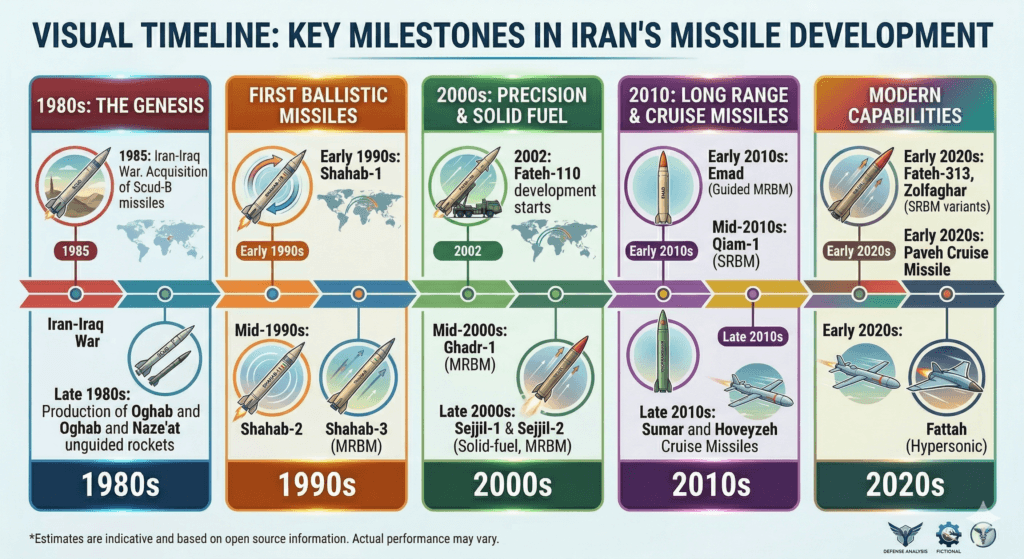
Understanding the Iran missile arsenal is easier if you follow the key milestones step by step. Here is a simplified timeline based on open‑source chronologies and expert reports:
1980s – Import and survival phase
Iran acquires its first Scud‑B missiles from Libya, followed by deliveries from North Korea and others during the Iran–Iraq War.
In 1984, the Islamic Revolutionary Guard Corps (IRGC) forms a dedicated missile team and sends officers to Syria and Libya for training on Scud systems.
1990s – Reverse engineering and local production
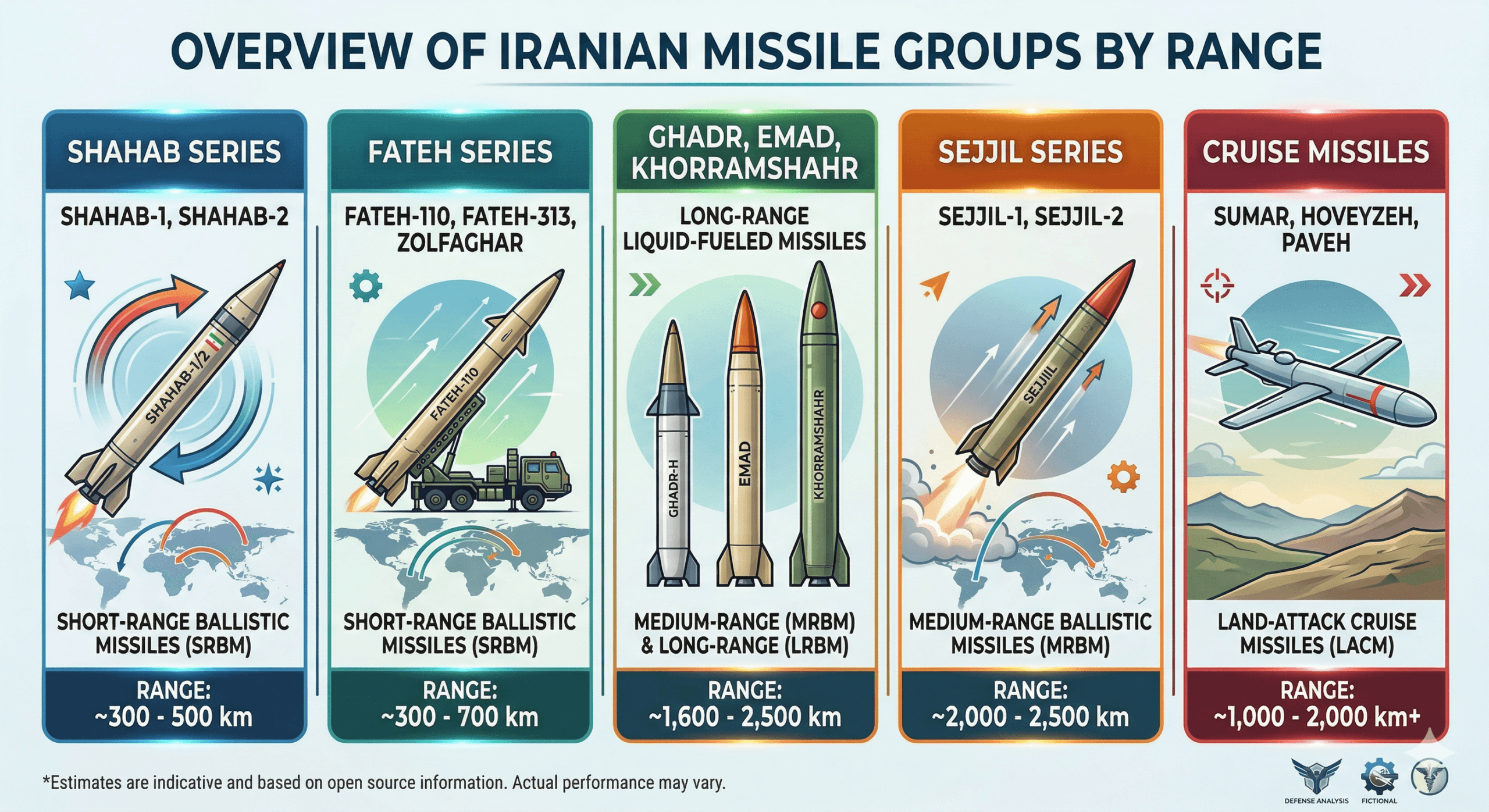
Iran begins to reverse‑engineer Scud technology, leading to the Shahab‑1 and Shahab‑2 short‑range ballistic missiles with ranges around 300–500 km.
Development of longer‑range prototypes starts, often under heavy secrecy, with support from North Korean and possibly Chinese designs.
2000s – Medium‑range deployment
The Shahab‑3, a medium‑range ballistic missile with a range of roughly 1,300 km, becomes the core of Iran’s regional strike capability.
Iran begins testing two‑stage and solid‑fuel systems, such as early Sejjil prototypes, signaling a move toward more advanced, survivable missiles.
2010s – Precision and diversification
Iran invests in guidance upgrades, producing variants like Ghadr and Emad that aim for better accuracy and longer ranges up to roughly 1,800–2,000 km.
The Fateh family of solid‑fuel SRBMs grows quickly, with variants from 200 km up to 1,000+ km, often advertised as “precision‑strike” weapons.
2020s – Hypersonic claims and combat use
Iran unveils new systems like Kheibar Shekan, Haj Qassem, and Fattah‑1/Fattah‑2, claiming high precision and, in some cases, hypersonic speeds with ranges around 1,400–1,500 km.
Missiles are used in real conflicts and retaliatory strikes across the region, including attacks on U.S. and Israeli‑linked targets, demonstrating the political importance of the Iran missile arsenal.
Main Categories in the Iran Missile Arsenal
Analysts usually group the Iran missile arsenal into several broad categories based on range, propulsion, and role. These categories matter because they affect how quickly a missile can be launched, how hard it is to intercept, and what targets it can reach.
Short‑Range Ballistic Missiles (SRBMs)
Short‑range ballistic missiles generally have ranges below about 1,000 km and are designed to hit nearby enemies or regional bases. In Iran’s case, SRBMs cover much of the Persian Gulf region, including parts of Iraq, the Gulf monarchies, and possibly parts of Turkey and Pakistan depending on launch points.
Key SRBMs in the Iran missile arsenal include the Shahab‑1 and Shahab‑2, derived from Scud‑B and Scud‑C missiles, as well as a growing family of solid‑fuel Fateh variants like Fateh‑110, Fateh‑313, Raad‑500, Zolfaghar, Dezful, and others. These missiles typically carry conventional warheads of several hundred kilograms and are increasingly marketed as “precision” weapons with improved guidance.
Medium‑Range Ballistic Missiles (MRBMs)
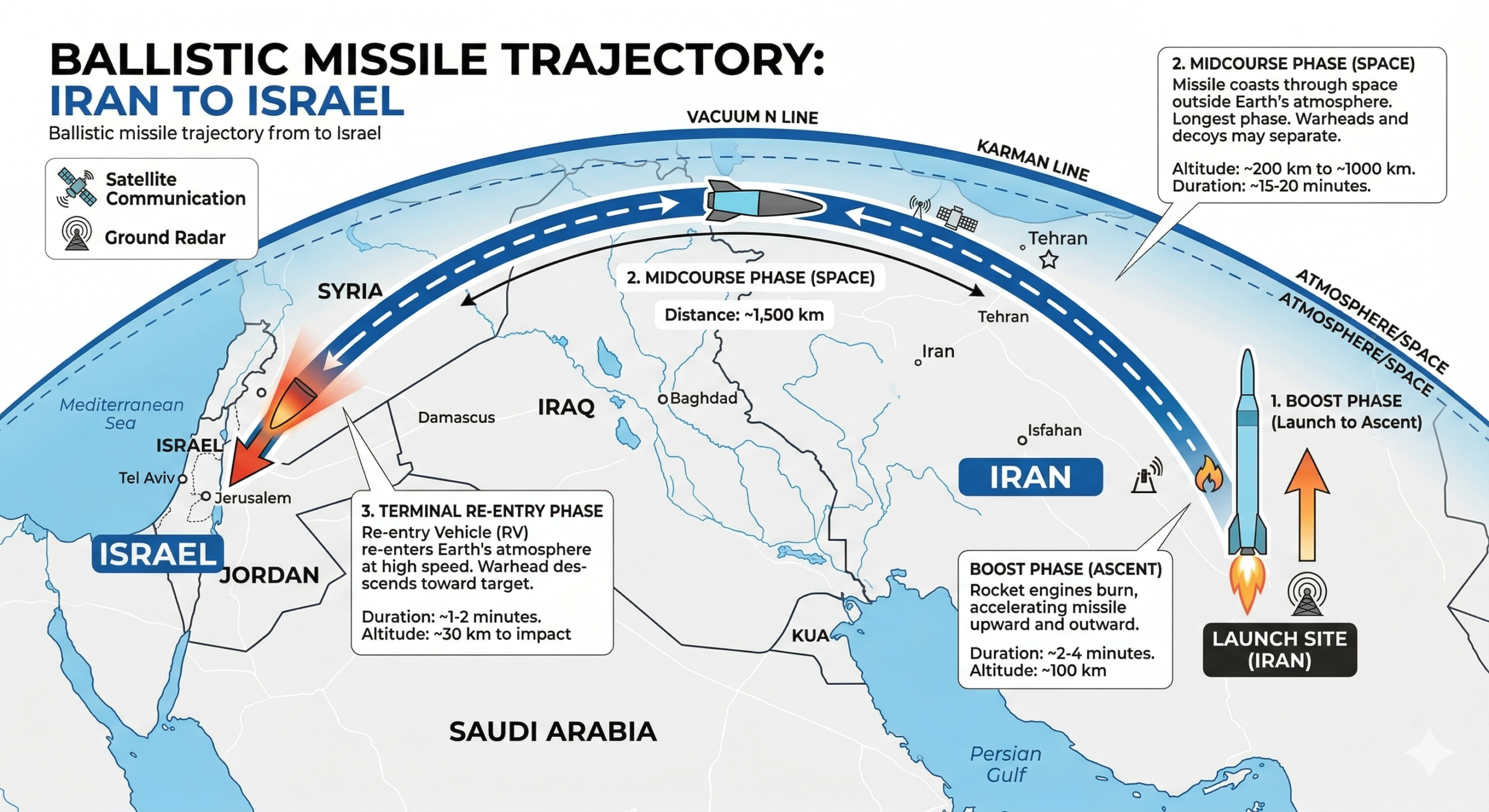
Medium‑range ballistic missiles can travel roughly 1,000–3,000 km and are central to Iran’s ability to reach Israel and much of southeastern Europe from its own territory. Iran’s MRBM portfolio includes Shahab‑3, Ghadr, Emad, Khorramshahr, Sejjil, and newer designs like Haj Qassem and Kheibar Shekan.
These systems are a major focus of international concern because they can, in theory, deliver either large conventional warheads or, if Iran ever built them, nuclear warheads over regional‑to‑intermediate distances. Reports from Western intelligence agencies have repeatedly stressed that Iranian MRBMs are “inherently capable” of carrying weapons of mass destruction, even as Iran denies plans to acquire such weapons.
Cruise Missiles and Anti‑Ship Missiles
Unlike ballistic missiles, cruise missiles fly at lower altitudes, often using wings and jet engines to travel longer distances with more flexible flight paths. Iran has invested in both land‑attack cruise missiles and anti‑ship cruise missiles to threaten naval forces in the Persian Gulf and beyond.
Systems such as Ra’ad, Soumar, Hoveyzeh, Ya‑Ali, and Abu Mahdi represent different cruise missile families, with reported ranges from around 350 km up to possibly 1,300 km or more in some variants. These weapons can be launched from land platforms and, in some cases, ships or aircraft, giving the Iran missile arsenal important flexibility against both sea and land targets.
Space Launch Vehicles and Dual‑Use Systems
Iran has also developed space launch vehicles (SLVs) like Safir and Simorgh, officially to put satellites into orbit. While these rockets are not classified as weapons, they use many of the same technologies—powerful multi‑stage rockets, guidance systems, and re‑entry knowledge—that are relevant to long‑range ballistic missiles.
Western governments therefore see Iran’s SLV program as part of a broader dual‑use technology base that could, in the long term, support intercontinental missile development if Iran chose that path. Iran, for its part, frames these projects as part of its civilian space ambitions and a symbol of technological progress.
Key Missile Families Inside Iran’s Arsenal
To understand the Iran missile arsenal in detail, it helps to look at the main missile “families” and how they evolved from each other. These families share components, technologies, and often names, making them easier to track.
Shahab Family
The Shahab (“meteor”) family grew directly out of imported Scud missiles and forms the historical backbone of Iran’s ballistic arsenal.
Shahab‑1
Origin: Based on the Soviet Scud‑B.
Range: Roughly 300–330 km.
Role: Short‑range strikes on nearby cities and bases, widely used during and after the Iran–Iraq War.
Shahab‑2
Origin: Derived from Scud‑C with extended fuel tanks.
Range: Around 500 km.
Role: Deeper strikes into neighboring countries, though still short‑range by global standards.
Shahab‑3
Origin: Based on North Korea’s Nodong missile but modified in Iran.
Range: Approximately 1,300 km, falling into the MRBM category.
Role: Regional deterrence, capable of reaching Israel and parts of southeastern Europe from western Iran.
Over time, Iran has reportedly deployed dozens to hundreds of Shahab‑series missiles, though many of them are now being supplemented or replaced by newer designs.
Fateh Family
The Fateh (“victor”) family represents Iran’s main solid‑fuel short‑range and medium‑range missile line, prized for faster launch times and easier storage.
Fateh‑110
Range: Around 200–350 km.
Features: Road‑mobile, solid‑fuel SRBM with a warhead of roughly 300–650 kg, used as the base for several variants, including anti‑ship and anti‑radar models like Khalij Fars and Hormuz.
Fateh‑313
Range: About 500 km, extending the reach of the original Fateh design.
Role: Deeper strikes with better survivability because of solid fuel and mobile launchers.
Raad‑500, Zolfaghar, Dezful, Haj Qassem
Range: These variants stretch from about 700 km (Zolfaghar) to 1,400 km (Haj Qassem), blurring the line between SRBM and MRBM.
Features: Lighter composite structures, improved guidance, and, in some cases, claimed accuracy within tens of meters, though external verification is limited.
This solid‑fuel expansion is one reason many experts say the Iran missile arsenal is becoming more survivable and dangerous from a military planning perspective.
Ghadr, Emad, and Khorramshahr
These missiles represent upgraded or alternative MRBM designs that build on the Shahab‑3 base but aim for more range and accuracy.
Ghadr
Range: Roughly 1,600–2,000 km, depending on the variant and payload.
Features: Improved aerodynamics and engine modifications to extend reach and possibly reduce launch preparation times.
Emad
Range: Around 1,700–1,800 km.
Features: Equipped with a new nose cone and small winglets designed to steer the warhead during re‑entry, aiming at higher precision compared with basic Shahab‑3 designs.
Khorramshahr series
Range: Claims range from about 2,000 up to possibly 3,000 km in some versions, with large warheads of 1,500–1,800 kg reported.
Role: Heavy MRBM intended to threaten distant strategic targets, though its exact performance remains debated among analysts.
These systems are frequently showcased in military parades and state media, reflecting their political and symbolic importance inside the Iran missile arsenal.
Sejjil and Solid‑Fuel MRBMs
The Sejjil program marks Iran’s shift from liquid‑fuel MRBMs to more advanced two‑stage solid‑fuel missiles, which are harder to detect and disrupt before launch.
Sejjil‑2
Range: About 2,000 km, covering all of Israel and large parts of southeastern Europe.
Features: Two‑stage solid‑fuel design that promises faster launch and better survivability than liquid‑fuel options like Shahab‑3 or Ghadr.
Although open‑source reports disagree on the exact number of Sejjil missiles and their operational status, most agree that successful tests prove Iran has mastered at least some key solid‑fuel MRBM technologies.
New Systems: Kheibar Shekan, Fattah, and Hypersonic Claims
In the early‑to‑mid 2020s, Iran announced several new missiles that it claims are more accurate, longer‑ranged, or even hypersonic.
Kheibar Shekan
Range: Around 1,450 km.
Features: A solid‑fuel MRBM advertised as a precision weapon capable of hitting targets across the region.
Haj Qassem
Range: Estimated around 1,400 km.
Role: Continuation of the Fateh‑family trend toward longer‑range, solid‑fuel missiles with better guidance.
Fattah‑1 and Fattah‑2
Range: Reported at about 1,400–1,500 km.
Claims: Iranian officials describe Fattah as a “hypersonic” missile capable of maneuvering at high speeds up to around Mach 13, which would complicate interception if true.
Independent experts remain cautious about some of these performance claims, but they agree that Iran is clearly pushing for faster, more maneuverable, and more precise missiles in its arsenal.
Range and Accuracy: How Far Can Iran’s Missiles Go?
The Iran missile arsenal covers distances from under 200 km to about 2,000 km, maybe more in some designs, giving Iran the ability to hit targets across almost the entire Middle East.
A simplified view of ranges looks like this (approximate figures):
Short‑range ballistic missiles (SRBMs)
Shahab‑1: ~300 km.
Shahab‑2: ~500 km.
Fateh‑110 series: ~200–350 km.
Zolfaghar: ~700 km.
Medium‑range ballistic missiles (MRBMs)
Shahab‑3: ~1,300 km.
Ghadr: ~1,600–2,000 km.
Emad: ~1,700–1,800 km.
Sejjil, Sejjil‑2: ~2,000 km.
Khorramshahr variants: ~2,000–3,000 km (claimed).
Cruise missiles
Ra’ad: ~350 km.
Ya‑Ali: ~700 km.
Soumar and Hoveyzeh: reported ~700–1,300 km and beyond.
Accuracy is harder to measure from open sources, but Iran increasingly claims circular error probable (CEP) in the tens of meters for newer missiles, especially Fateh‑derived systems and upgraded MRBMs. Western and regional analysts accept that Iranian accuracy has improved over time, citing relatively precise strikes in Iraq and Syria, even if state propaganda may exaggerate some numbers.
Who Controls the Iran Missile Arsenal?
Two main institutions oversee the development and deployment of the Iran missile arsenal.
Aerospace Industries Organization (AIO)
Role: Acts as an umbrella for many of Iran’s missile production and research entities, responsible for design, testing, and manufacturing.
Importance: AIO and its subsidiaries have repeatedly appeared in sanctions lists for procuring missile components and technology abroad.
Islamic Revolutionary Guard Corps (IRGC) Aerospace Force
Role: Operates most of Iran’s ballistic missile units, including road‑mobile launchers, underground bases, and missile “cities.”
Command: The IRGC Aerospace Force is led by senior commanders who openly emphasize missiles as Iran’s key deterrent against the U.S., Israel, and regional rivals.
Supporting organizations, like the Self‑Sufficiency Jihad Organization (SSJO), work on advancing guidance systems, solid propellants, and other specialized technologies for the Iran missile arsenal.
Case Studies: How Iran Has Used Missiles in Real Conflicts
Real‑world use of missiles provides valuable clues about how Iran sees its arsenal—not just as a symbol, but as a practical tool. Several high‑profile episodes have been documented in open sources:
War with Iraq (1980s)
Iran launched more than 100 Scud‑type missiles against Iraqi economic and population centers during the “War of the Cities,” mirroring Iraq’s own missile attacks.
These early uses were relatively inaccurate but showed Iran’s willingness to respond in kind and shaped its long‑term dependence on missiles.
Strikes on ISIS and militants in Syria and Iraq
In the late 2010s, Iran used Fateh and Zolfaghar missiles to hit Islamic State and other militant targets in Syria and Iraq, framing those operations as retaliation for attacks on Iranian territory.
Videos released by state media showed missiles launching from western Iran and hitting buildings hundreds of kilometers away, supporting claims of improved accuracy.
Retaliatory attacks on U.S. bases
After U.S. actions against Iranian interests, Iran fired ballistic missiles at U.S.‑linked bases in Iraq, including the well‑known January 2020 strike on Ayn al‑Asad air base.
While the U.S. took protective measures, the damage to infrastructure and the precision of several impacts highlighted how seriously militaries now treat the Iran missile arsenal.
Escalations with Israel and regional tensions
Reports in 2025 and 2026 describe Iranian missile salvos targeting Israeli and U.S.‑aligned positions during a short but intense conflict, with Israel responding through airstrikes that destroyed many launchers.
These events underline how Iran’s missiles both raise deterrence and risk rapid escalation if crises get out of control.
In every case, Iranian officials used missile strikes not just militarily but politically, signaling strength at home and abroad.
Regional and Global Reactions to Iran’s Missile Arsenal
The Iran missile arsenal has shaped defense planning across the Middle East and beyond.
United States and NATO
U.S. intelligence and defense reports repeatedly state that Iran has the largest ballistic missile inventory in the region and see it as a growing threat to regional bases and allies.
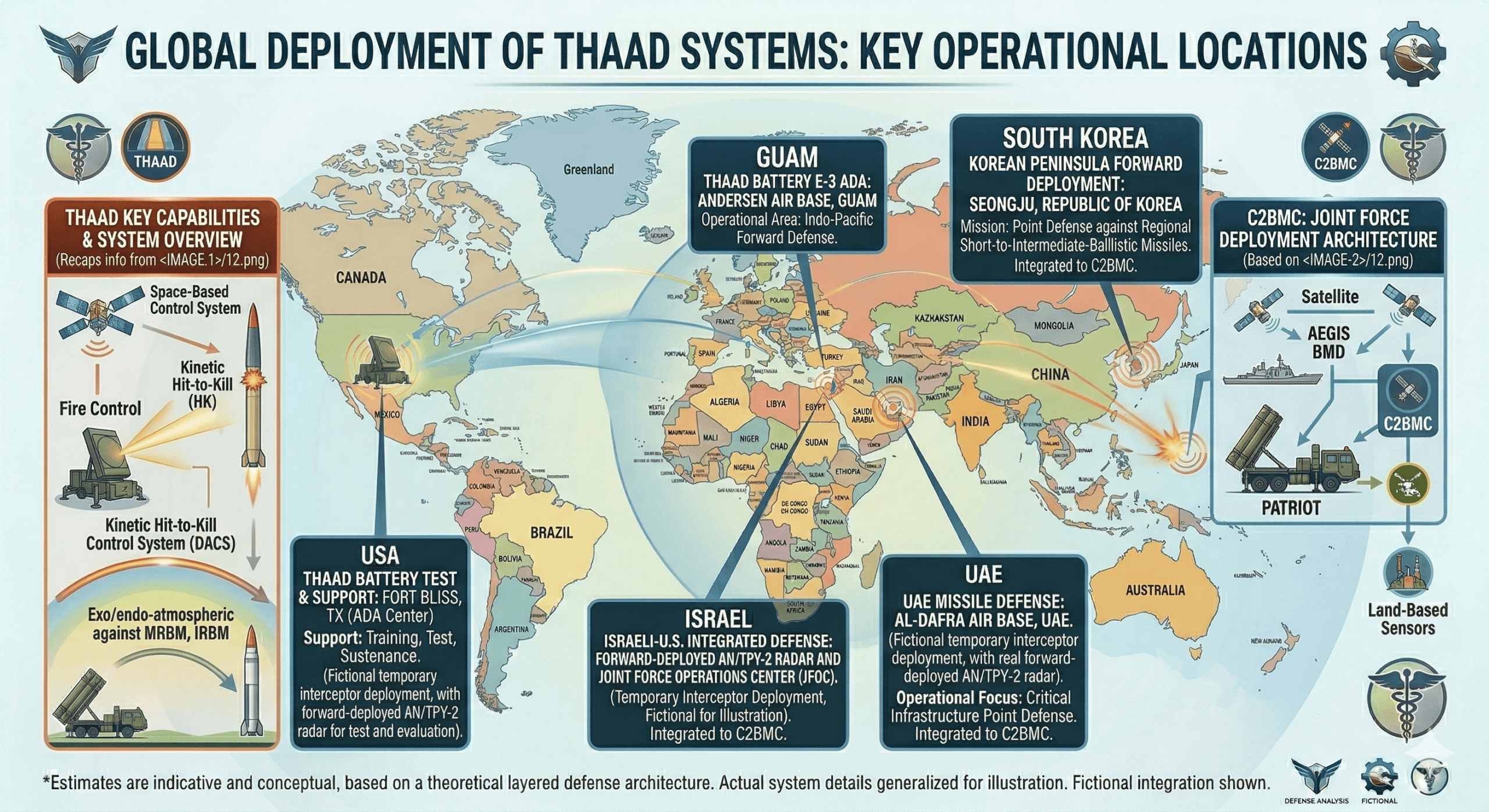
This has driven investments in missile defense systems like Patriot, THAAD, and Aegis‑equipped ships deployed around the Persian Gulf and Eastern Mediterranean.
Israel and Gulf monarchies
Israel invests heavily in multi‑layered missile defense (Iron Dome, David’s Sling, Arrow) specifically to counter short‑ and medium‑range missiles from Iran and its proxies.
Gulf states like Saudi Arabia, the UAE, and Qatar have bought advanced surface‑to‑air and missile defense systems to protect oil infrastructure and cities from potential Iranian strikes.
Europe and global diplomacy
As Iranian MRBM ranges reach or approach parts of southeastern Europe, European governments pay closer attention, linking missile issues to nuclear talks and sanctions.
International agreements like the Joint Comprehensive Plan of Action (JCPOA) focused mainly on nuclear issues, but many Western officials argued that Iran’s missiles should be part of any future comprehensive deal.
Think tanks such as the International Institute for Strategic Studies (IISS), SIPRI, and U.S. government agencies regularly publish assessments of the Iran missile arsenal, underlining how central missiles are to global debate about Iran’s role in the region.
Future Trends in Iran’s Missile Development
Open‑source analysis suggests several clear trends for the future of the Iran missile arsenal.
More solid‑fuel, road‑mobile missiles
Iran is likely to keep shifting from large, fuel‑hungry liquid missiles to lighter, solid‑fuel systems that can launch quickly and hide in tunnels or underground “missile cities.”
Higher precision and better guidance
Investments in terminal guidance, satellite navigation, and maneuvering re‑entry vehicles are all aimed at turning missiles from area‑bombardment tools into precision‑strike weapons.
Integration with drones and real‑time targeting
Iran is expanding its drone fleet, and experts expect tighter integration between drones and missiles for better target identification and damage assessment.
More cruise missiles and naval options
As Iran builds up anti‑ship and land‑attack cruise missiles with longer ranges, regional navies will have to plan for more complex, multi‑axis threats from both ballistic and cruise missiles.
Ongoing external procurement under sanctions
Despite sanctions, Iran continues to seek foreign materials like solid‑fuel oxidizers, illustrating how outside suppliers still play a role in sustaining and expanding its missile production.
In short, the Iran missile arsenal is already large and diverse, and most independent experts think it will grow more sophisticated even if international pressure slows, but does not stop, progress.
Conclusion
The Iran missile arsenal has grown from a handful of imported Scud missiles in the 1980s into a dense, multi‑layered inventory of short‑range, medium‑range, ballistic, and cruise missiles that shape the entire security landscape of the Middle East. With ranges up to about 2,000 km, improving accuracy, and a heavy focus on solid‑fuel, road‑mobile systems, Iran’s missiles are now a central tool of deterrence, signaling, and, at times, direct military action.
If you run a news site, defense blog, or educational platform, you can now build on this guide by adding regional case studies, missile defense analysis, or interactive maps that visualize the Iran missile arsenal for your audience.
1. How big is Iran’s missile arsenal compared with other countries in the Middle East?
1. How big is Iran’s missile arsenal compared with other countries in the Middle East? Open‑source assessments from U.S. intelligence and think tanks say Iran has the largest and most diverse ballistic missile arsenal in the Middle East in terms of total missiles and launchers. Estimates suggest Iran may have hundreds of launchers and well over 1,000 short‑ and medium‑range ballistic missiles available.
2. What is the maximum range of Iran’s missiles?
Most credible public sources put Iran’s operational missile range ceiling at around 2,000 km, which includes systems like Sejjil and some Ghadr or Emad variants. Claims that certain Khorramshahr versions might reach up to 3,000 km exist, but these are less firmly documented and often debated.
3. Can Iran’s missiles reach Europe?
From launch sites inside Iran, missiles with ranges around 2,000 km can reach all of Israel and parts of southeastern Europe, including sections of Greece, Bulgaria, and Romania. Longer‑range claims, if ever realized, would extend coverage further into Europe, which is why European governments follow the Iran missile arsenal closely.
4. Are Iran’s missiles accurate or mostly for terror and intimidation?
Early Scud‑type missiles used by Iran were quite inaccurate and mainly served as psychological and area‑bombardment tools, especially during the Iran–Iraq War. However, newer Fateh‑family and upgraded MRBMs like Emad and Kheibar Shekan are openly promoted as precision systems, and Iran has demonstrated improving accuracy in strikes on targets in Iraq and Syria.
5. Does Iran’s missile program violate international agreements?
Iran argues that its missile program is legal because it is focused on conventional deterrence and self‑defense. Western governments say that some Iranian missile tests and developments contradict the spirit of United Nations resolutions and pose risks due to their potential compatibility with nuclear warhead
6. What role do cruise missiles play in the Iran missile arsenal?
Cruise missiles like Ra’ad, Soumar, Hoveyzeh, and Abu Mahdi give Iran more flexible options for low‑altitude, long‑range attacks that can follow complex flight paths compared with ballistic missiles. They are particularly important for anti‑ship missions in the Persian Gulf and for striking fixed land targets from standoff distances.
7. Is Iran really developing hypersonic missiles?
Iran has unveiled missiles under the Fattah label and described them as “hypersonic,” claiming speeds of up to Mach 13 and advanced maneuvering. Independent analysts acknowledge that Iran is clearly pursuing faster, more agile missiles but remain cautious until more verifiable flight‑test data is available.
8. How does Iran hide and protect its missile arsenal?
Iran widely uses road‑mobile launchers, hardened shelters, and underground tunnel complexes often referred to in media as “missile cities” to protect its arsenal from pre‑emptive strikes. These measures, combined with solid‑fuel missiles, make it harder for enemies to find and destroy launchers before they can fire