
If you are serious about understanding the universe, learning the types of black holes stellar intermediate supermassive primordial is a game‑changer. Astronomers now think our galaxy alone may contain millions of stellar black holes, a single supermassive giant at the center, and possibly a hidden population of primordial black holes formed in the first seconds after the Big Bang.
In this guide, we will explore each major category—stellar‑mass, intermediate‑mass, supermassive, and primordial—plus special cases like binary and merging black holes, all in simple language backed by real observations and statistics. By the end, you will be able to explain the main types of black holes stellar intermediate supermassive primordial to anyone, from school students to space‑nerd friends.
Table of Contents
- Why Classifying Black Holes Matters
- Overview: The Main Types of Black Holes
- Type 1: Stellar‑Mass Black Holes
- How Stellar Black Holes Form
- Stellar Black Hole Examples and Numbers
- Type 2: Intermediate‑Mass Black Holes
- Why Intermediate Black Holes Are the “Missing Link”
- Leading Theories for Their Formation
- Type 3: Supermassive Black Holes
- Supermassive Black Holes at Galaxy Centers
- How Do Supermassive Black Holes Grow So Big?
- Type 4: Primordial Black Holes
- Primordial Black Holes and the Early Universe
- Bonus Types: Binary, Merging, and Active Black Holes
- How the Types of Black Holes Stellar Intermediate Supermassive Primordial Fit Together
- FAQ: Types of Black Holes Stellar Intermediate Supermassive Primordial
- Conclusion
Why Classifying Black Holes Matters
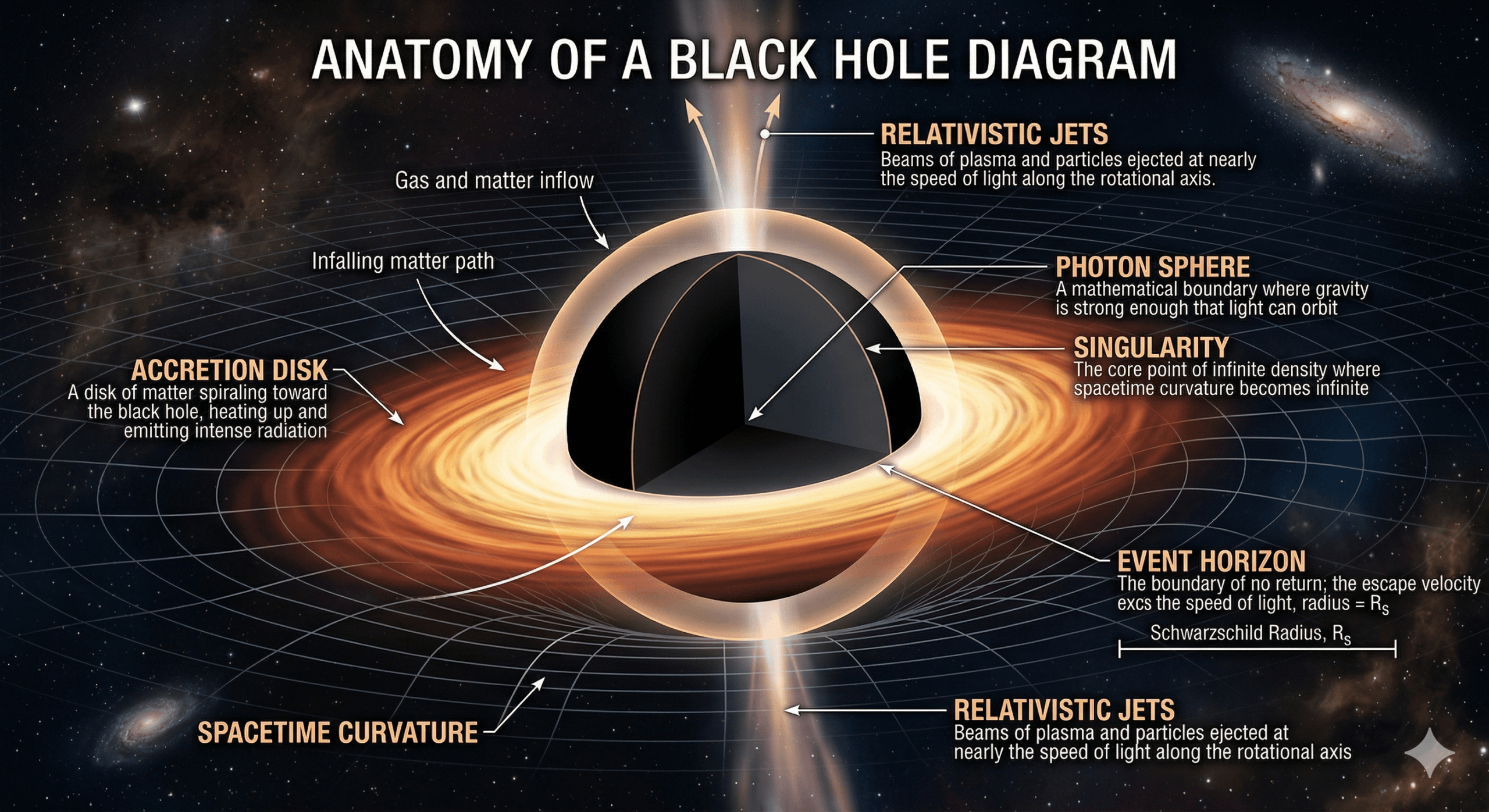
At first glance, a black hole is “just” a region where gravity is so strong that not even light can escape. But astronomers quickly realized that not all black holes are the same—they come in very different sizes and live in very different environments.
Knowing the types of black holes stellar intermediate supermassive primordial matters because each class answers a different question:
- Stellar black holes teach us about how massive stars die.
- Intermediate black holes reveal how small objects grow into giants.
- Supermassive black holes control the fate of entire galaxies.
- Primordial black holes may connect black holes to the Big Bang and possibly dark matter.
So classifying black holes is not just about labels; it is about understanding how the universe builds structure over 13.8 billion years.
Overview: The Main Types of Black Holes
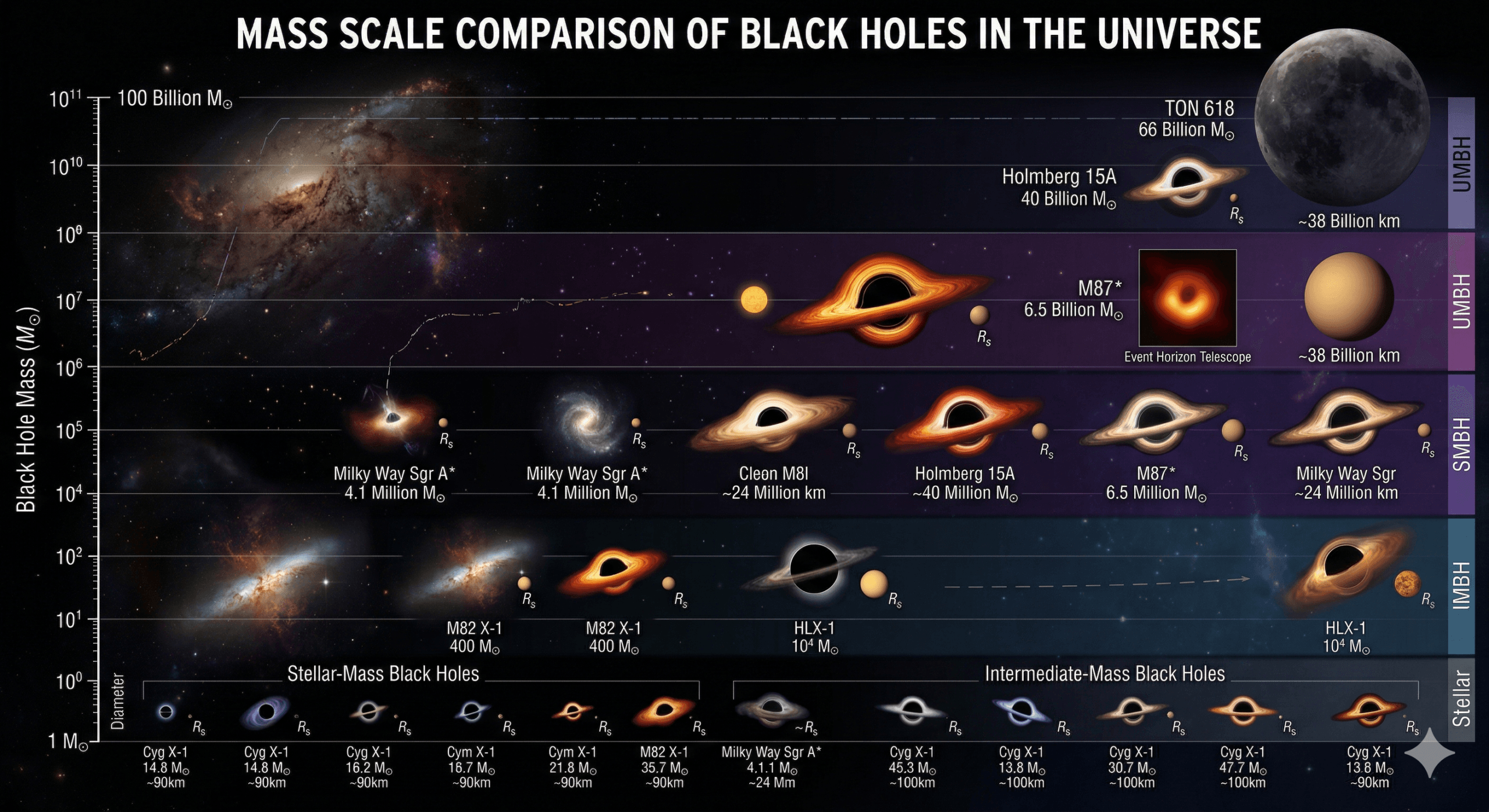
NASA and other major institutions usually list three main mass categories of black holes: stellar‑mass, intermediate‑mass, and supermassive, plus a theoretical fourth: primordial black holes.
Here is a quick overview of the types of black holes stellar intermediate supermassive primordial:
- Stellar‑mass black holes
- Mass: About 5 to a few tens of times the Sun’s mass.
- Formed by the collapse of massive stars.
- Intermediate‑mass black holes (IMBHs)
- Mass: Roughly 100 to hundreds of thousands of solar masses.
- Rare and hard to confirm; may form through mergers or dense star cluster collapse.
- Supermassive black holes (SMBHs)
- Mass: Millions to billions of solar masses.
- Found at the centers of most large galaxies, including the Milky Way.
- Primordial black holes (PBHs)
- Mass: Can range from asteroid‑size or smaller to thousands or millions of sols, depending on when they formed in the early universe.
- Hypothetical so far, but actively researched.
With this map in mind, let us dive into each type in detail.
Type 1: Stellar‑Mass Black Holes
How Stellar Black Holes Form
Stellar‑mass black holes are the smallest of the main observed categories and the easiest to explain.
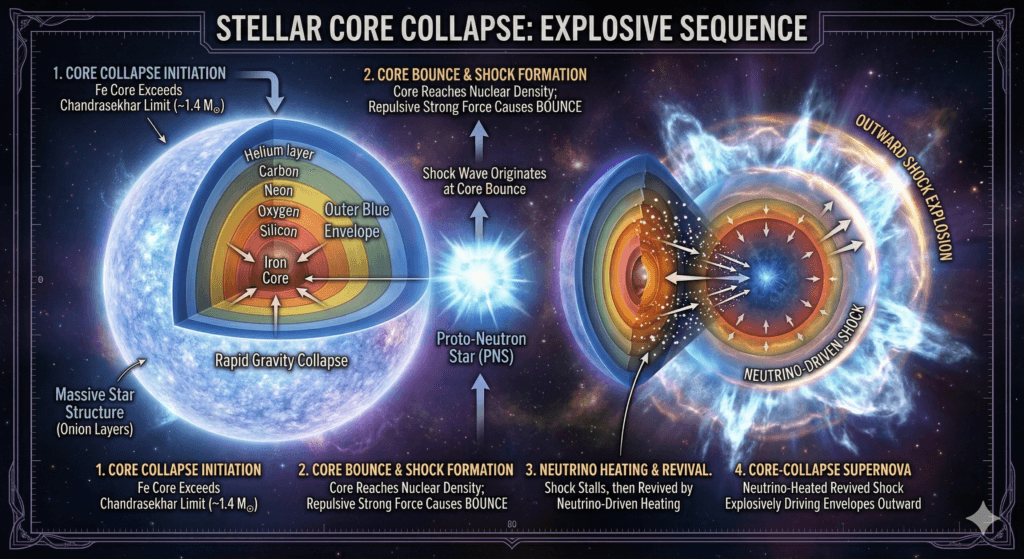
They typically form when:
- A star at least about 8–20 times the mass of the Sun exhausts its nuclear fuel.
- Without the pressure from fusion, the core collapses inward under its own weight.
- If the core remnant is above a certain mass (roughly a few solar masses), no known force can stop the collapse.
- The core implodes into a black hole, sometimes after a powerful supernova explosion.
NASA notes that if the original star is about 20 solar masses or more, its core is likely to form a stellar‑mass black hole, whereas less massive cores may form neutron stars instead.
This process is central to the types of black holes stellar intermediate supermassive primordial because it provides the basic “seeds” that can later merge and grow into larger classes.
Stellar Black Hole Examples and Numbers
We cannot see stellar black holes directly, but we can infer them from their effects on nearby matter:
- X‑ray binaries: Many suspected stellar black holes are found in binary systems where the black hole pulls gas off a companion star, forming a hot accretion disk that emits X‑rays.
- Known vs. expected numbers: NASA lists around 50 suspected or confirmed stellar‑mass black holes in the Milky Way, but estimates suggest there may be up to 100 million in our galaxy alone.
These objects also produce many of the gravitational‑wave signals detected by LIGO and Virgo, when pairs of stellar black holes merge. Those events give us precise mass and spin measurements and help map out the population of this first category in the types of black holes stellar intermediate supermassive primordial.
Type 2: Intermediate‑Mass Black Holes
Why Intermediate Black Holes Are the “Missing Link”
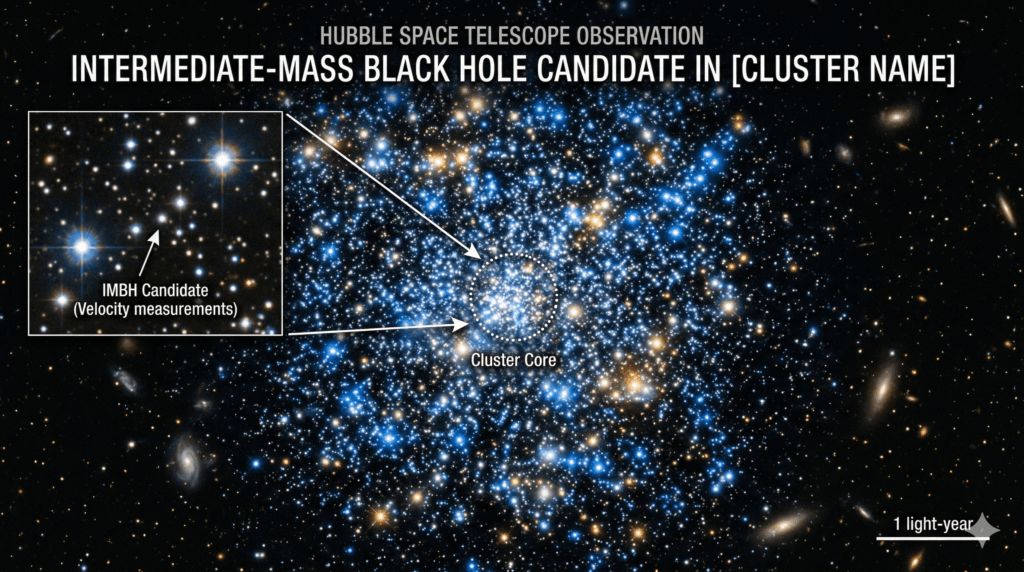
Intermediate‑mass black holes (IMBHs) were predicted long before any strong candidates were found. They fill the gap between stellar‑mass black holes (up to a few tens of solar masses) and supermassive black holes (millions to billions of solar masses).
- IMBHs are expected to have masses from hundreds to hundreds of thousands of solar masses.
- They might live in dense star clusters, dwarf galaxies, or off‑center locations inside larger galaxies.
However, confirming them is hard:
- They are less active than supermassive black holes and less bright in many cases.
- Their gravitational influence is subtler, making precise mass measurements more difficult.
Because of this, scientists call them the “missing link” in the types of black holes stellar intermediate supermassive primordial.
Leading Theories for Their Formation
There are several ideas about how IMBHs might form:
- Runaway mergers in star clusters
Stellar‑mass black holes in dense globular clusters could merge repeatedly, building up an IMBH over time. - Direct collapse of massive gas clouds
Large, dense gas clouds in the early universe might collapse directly into IMBHs, skipping the stellar stage. - Primordial origin
The 2024 MNRAS Letters paper suggests some intermediate and supermassive black holes could actually be primordial, formed from density fluctuations in the first seconds after the Big Bang.
These formation channels link IMBHs to both stellar and primordial black holes, making them a key bridge in the overall types of black holes stellar intermediate supermassive primordial picture.
Type 3: Supermassive Black Holes
Supermassive Black Holes at Galaxy Centers
Supermassive black holes (SMBHs) sit at the centers of most large galaxies, including our Milky Way.
Key facts:
- Typical masses: Millions to billions of solar masses.
- Location: Nearly always at a galaxy’s dynamical center.
- Examples:
- Sagittarius A* at the Milky Way’s center, ~4.3 million solar masses.
- M87* in the galaxy Messier 87, about 6.5 billion solar masses.
Astronomers track stars orbiting close to Sgr A* to measure its mass; one star called S2 has a 16‑year orbit that passes within just a light‑day or so of the black hole. These precise measurements are some of the strongest evidence for SMBHs and help anchor the “supermassive” category in the types of black holes stellar intermediate supermassive primordial.
How Do Supermassive Black Holes Grow So Big?
There is still active debate about exactly how SMBHs reached their enormous sizes so quickly in cosmic history, but leading ideas include:
- Accretion of gas over billions of years
Gas spirals in via an accretion disk, releasing energy and building up the black hole’s mass. - Mergers of smaller black holes
During galaxy collisions, central black holes can merge, producing gravitational waves and forming heavier SMBHs. - Seeds from massive or primordial black holes
Some models suggest that early universe conditions created massive seeds—either direct‑collapse black holes or primordial black holes—that later grew into the SMBHs we see today.
Regardless of the exact pathway, supermassive black holes are now understood to regulate star formation and galaxy evolution through their gravity and energetic output, making them central in any discussion of the types of black holes stellar intermediate supermassive primordial.
Type 4: Primordial Black Holes
Primordial Black Holes and the Early Universe
Primordial black holes (PBHs) are the most speculative but also the most exciting category in the types of black holes stellar intermediate supermassive primordial.
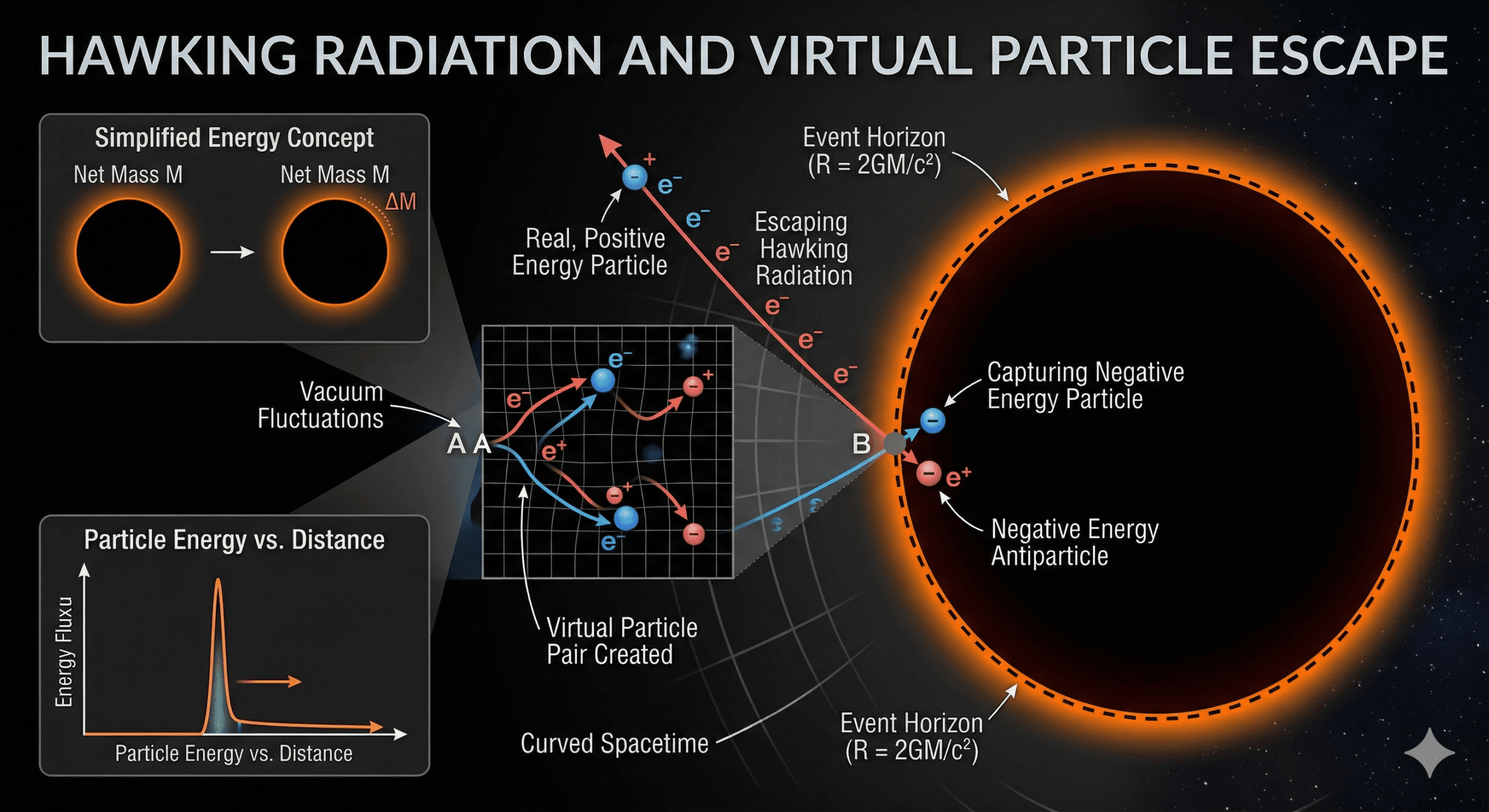
Instead of forming from stars, PBHs would have formed in the first fractions of a second after the Big Bang, when extremely dense regions in the hot early universe collapsed under their own gravity.
Key points:
- PBHs can, in principle, span a huge mass range—from less than an asteroid to thousands or millions of solar masses—depending on when they formed.
- A 2024 MNRAS Letters paper shows that during the electron–positron annihilation epoch (around one second to 1000 seconds after the Big Bang), density fluctuations could have formed primordial black holes with masses from about 5,000 to 500 million Suns, potentially explaining some intermediate and supermassive black holes.
- If they exist in large numbers, PBHs could contribute to or even explain some of the dark matter in the universe.
So far, no primordial black hole has been unambiguously confirmed, but gravitational lensing surveys, cosmic microwave background data, and gravitational‑wave detections are all being used to search for them.
Bonus Types: Binary, Merging, and Active Black Holes
Beyond the types of black holes stellar intermediate supermassive primordial, astronomers often describe black holes by behavior:
- Binary black holes – Systems where two black holes orbit each other. When they merge, they emit strong gravitational waves detected by LIGO, Virgo, and KAGRA.
- Merging black holes – The final stages of binary evolution; mergers like GW231123 and later events involve black holes up to hundreds of solar masses, sometimes in “forbidden” mass ranges hard to explain.
- Active galactic nuclei (AGN) / quasars – Supermassive black holes actively accreting large amounts of gas, shining as some of the brightest objects in the universe.
These behavioral categories can overlap with the mass‑based types of black holes stellar intermediate supermassive primordial, but they help describe what black holes are doing right now, not just how big they are.
How the Types of Black Holes Stellar Intermediate Supermassive Primordial Fit Together
The types of black holes stellar intermediate supermassive primordial are not isolated boxes; they form a kind of evolutionary ladder and cosmic ecosystem:
- Stellar‑mass black holes are born from dying stars. They can:
- Merge with each other to create heavier stellar or intermediate black holes.
- Accrete gas and grow over time.
- Intermediate‑mass black holes may form from repeated mergers, direct collapse of gas clouds, or even as primordial objects. They could then sink toward galaxy centers and become seeds for supermassive black holes.
- Supermassive black holes dominate galaxy centers, shaping galaxy evolution and sometimes launching jets that stretch millions of light‑years.
- Primordial black holes—if they exist—may have provided some of the earliest seeds for both IMBHs and SMBHs and could still be hiding in large numbers throughout the universe as part of dark matter.
Seeing these connections helps you move from memorizing lists to truly understanding what the types of black holes stellar intermediate supermassive primordial tell us about cosmic history.
Conclusion and Call to Action
From the death of massive stars to the earliest moments after the Big Bang, the types of black holes stellar intermediate supermassive primordial trace the entire history of structure in our universe. Stellar‑mass black holes tell us how stars end, intermediate‑mass black holes bridge the gap to giants, supermassive black holes regulate galaxy evolution, and primordial black holes may connect gravity to the Big Bang and dark matter.
If you run a science blog, YouTube channel, or education site, this guide can serve as your pillar article on black hole types.
1. What are the main types of black holes?
Astronomers usually talk about three main observed categories—stellar‑mass, intermediate‑mass, and supermassive—plus a possible fourth: primordial black holes formed in the early universe. Together, these make up the types of black holes stellar intermediate supermassive primordial used in modern research.
2. How big are stellar‑mass black holes?
Stellar‑mass black holes typically range from about 5 to several tens of times the Sun’s mass and form when massive stars collapse at the end of their lives. Many are found in X‑ray binaries, and there may be up to 100 million in the Milky Way alone.
3. Why are intermediate‑mass black holes hard to find?
Intermediate‑mass black holes, with masses between roughly 100 and hundreds of thousands of suns, are fainter and less obvious than active supermassive black holes and harder to spot than stellar black holes in bright binaries. Confirming them requires precise measurements of star or gas motions or special gravitational‑wave or lensing signatures.
4. What is the largest type of black hole?
Supermassive black holes are the largest known type, with masses of millions to billions of Suns. They sit at galaxy centers and power quasars and active galactic nuclei when actively accreting gas—key players among the types of black holes stellar intermediate supermassive primordial.
5. Do primordial black holes really exist?
Primordial black holes are still hypothetical, but theory suggests they could have formed in the first seconds after the Big Bang from rare, dense regions in the early universe. Recent work shows they might even explain some intermediate and supermassive black holes if they formed during specific epochs like electron–positron annihilation.
6. How do gravitational waves help classify black holes?
Gravitational waves from black hole mergers let scientists measure masses and spins with high precision, revealing new populations, including very massive stellar black holes and potential second‑generation black holes. This helps fill gaps between the types of black holes stellar intermediate supermassive primordial and tests formation theories.
7. Can one type of black hole turn into another?
Yes. Stellar black holes can merge to form heavier stellar or intermediate‑mass black holes, and repeated mergers plus accretion may eventually build supermassive black holes. If primordial black holes exist, they could also act as seeds for larger types over cosmic time.

2 thoughts on “7 Mind‑Blowing Types of Black Holes: Stellar, Intermediate, Supermassive, Primordial”