If you have ever heard that nothing, not even light, can escape a black hole, you were really hearing a description of its event horizon—and you might still be wondering what is an event horizon simple explanation that actually makes sense. The event horizon is not a solid surface but a one‑way boundary in spacetime, the exact place where escape becomes impossible and the “black” in black hole truly begins.
In this guide, we will answer what is an event horizon simple explanation using plain English and 5 easy‑to‑visualize diagrams. You will see how escape velocity and light cones define the horizon, what happens as you cross it, how spinning black holes add an ergosphere, and how telescopes image the shadow created by this invisible boundary.
Table of Contents
- What Is an Event Horizon? Simple Definition
- Diagram 1: Escape Velocity and the Point of No Return
- Diagram 2: Light Cones – How Spacetime Traps Light
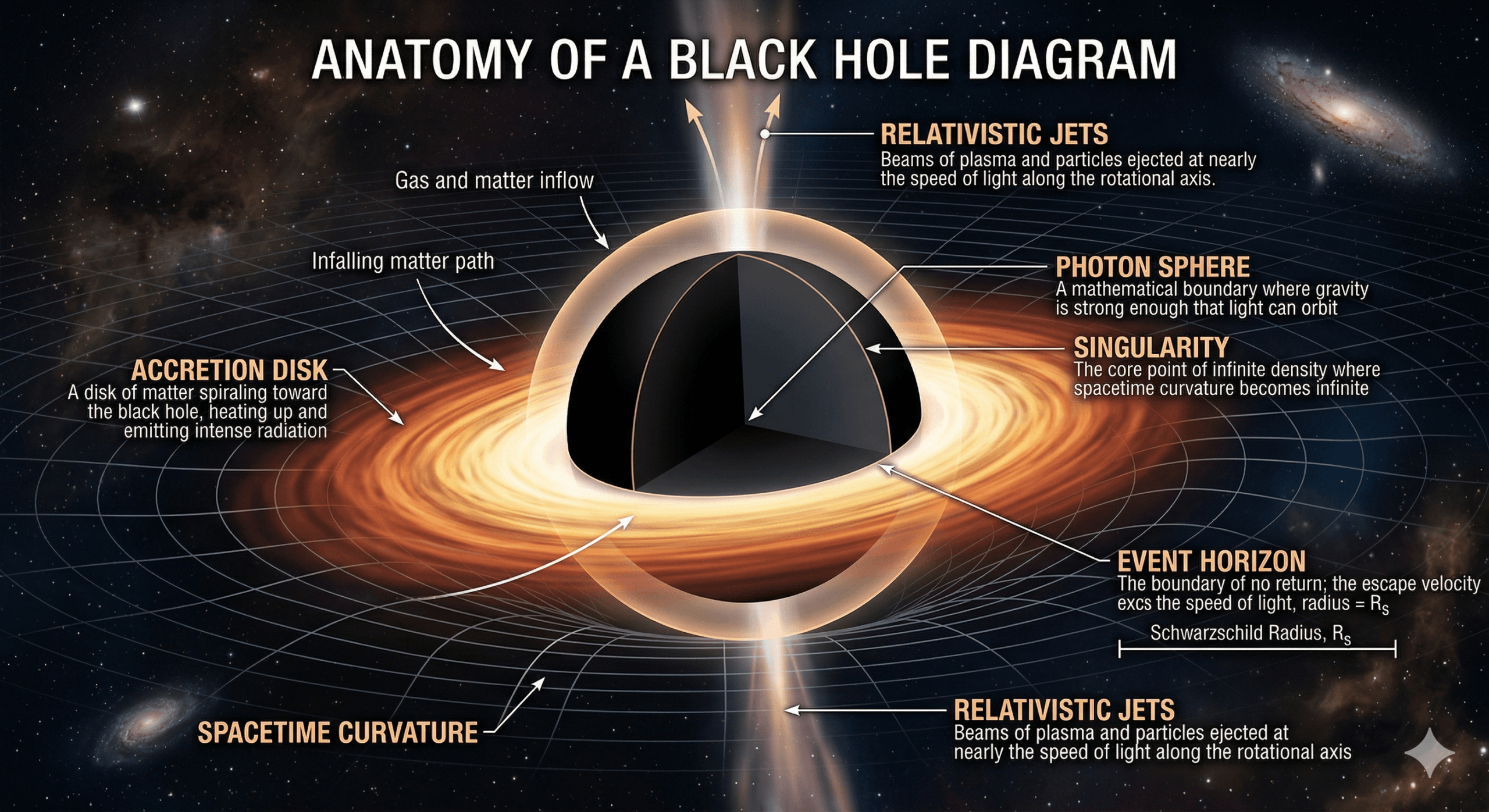
- Diagram 3: Black Hole Anatomy Around the Event Horizon
- Diagram 4: Spinning Black Holes, Ergosphere, and Event Horizon
- Diagram 5: Event Horizon Shadow and Real Images
- What Happens When You Cross the Event Horizon?
- Event Horizon vs Other Cosmic Horizons
- Why Event Horizons Matter in Modern Physics
- FAQ: What Is an Event Horizon? Simple Explanation
- Conclusion
What Is an Event Horizon? Simple Definition
Let us start with what is an event horizon simple explanation before we dive into diagrams.
An event horizon is the boundary around a black hole where the escape speed equals the speed of light. General relativity tells us that nothing can travel faster than light, so once something—matter, light, or signals—crosses that boundary heading inward, it can never come back out.
Another way to say it:
- Outside the event horizon, it is still theoretically possible to escape if you have enough energy.
- At the event horizon, escape would require you to outrun light, which is impossible.
- Inside the event horizon, every possible future path drags you inevitably toward the black hole’s center (the singularity).
So the clean answer to what is an event horizon simple explanation is: it is the invisible surface around a black hole that marks the point of no return for anything trying to escape.
Diagram 1: Escape Velocity and the Point of No Return
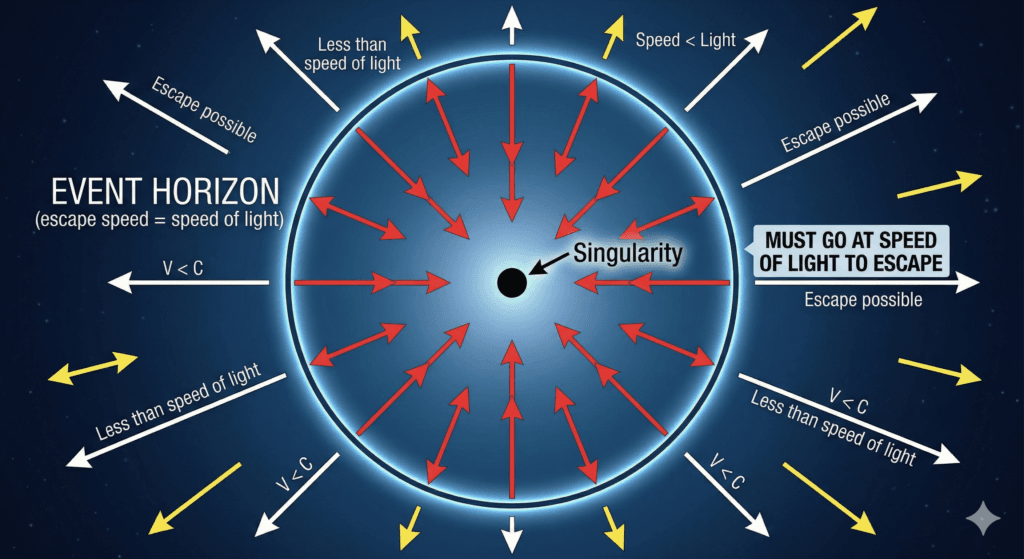
To visualize what is an event horizon simple explanation, start with a concept from basic physics: escape velocity.
- On Earth, you must travel about 11.2 km/s to escape Earth’s gravity.
- If you launch slower, gravity pulls you back.
- If a body is compact enough, the escape velocity at some distance can reach the speed of light.
For a non‑spinning black hole, this critical radius is the Schwarzschild radius. At that distance from the center, the escape speed exactly equals the speed of light, and that sphere is the event horizon.
How to sketch Diagram 1:
- Draw a black dot at the center representing the singularity.
- Draw a circle around it labeled “event horizon (escape speed = speed of light).”
- Outside the circle, show arrows labeled with speeds less than light; some arrows point outward (escape possible).
- On the circle, label an arrow “must go at speed of light to escape.”
- Inside the circle, draw inward arrows only—no outward escape paths.
This picture already captures what is an event horizon simple explanation: it is where the required escape speed hits the universal speed limit.
Diagram 2: Light Cones – How Spacetime Traps Light
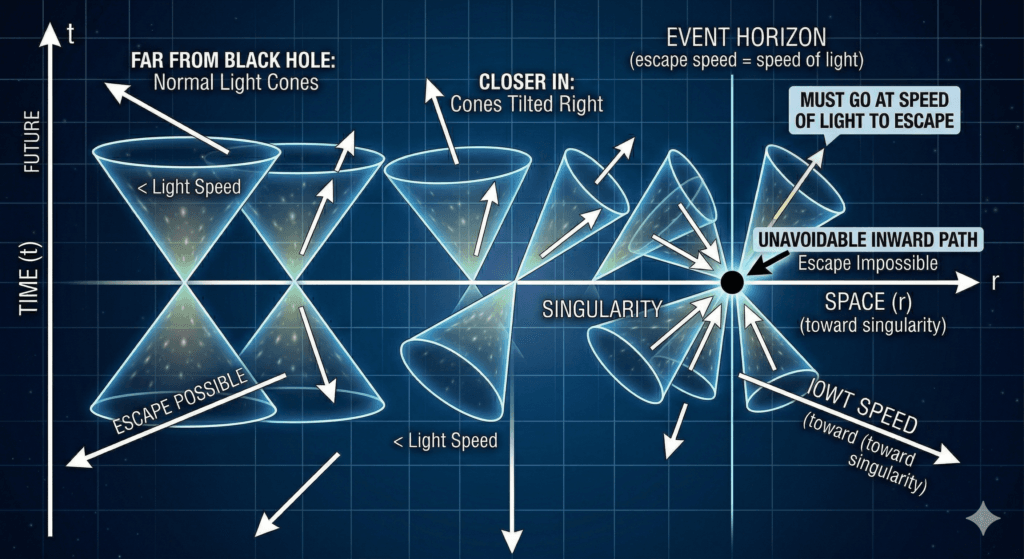
Einstein’s general relativity explains what is an event horizon simple explanation in terms of curved spacetime and light cones instead of just escape velocity.
A light cone at a point in spacetime shows all possible directions light can travel from that point. Outside a black hole, light cones tilt slightly toward the mass but still allow paths that move outward and escape.
As you approach the event horizon:
- Spacetime curvature becomes stronger.
- The light cones tip more toward the black hole.
- At the horizon, all future lightlike paths point inward—none point outward.
How to sketch Diagram 2:
- Draw a vertical time axis and horizontal space axis.
- Far from the black hole, draw symmetric light cones (like “V” shapes up and down), showing that some future paths move outward.
- Closer in, draw cones leaning toward the right (toward the black hole), with fewer outward paths.
- At the event horizon, draw cones tipped so far that all future directions lie inside the horizon and lead inward.
Seen this way, what is an event horizon simple explanation becomes: it is where spacetime is so curved that every future path, even for light, falls inward instead of outward.
Diagram 3: Black Hole Anatomy Around the Event Horizon
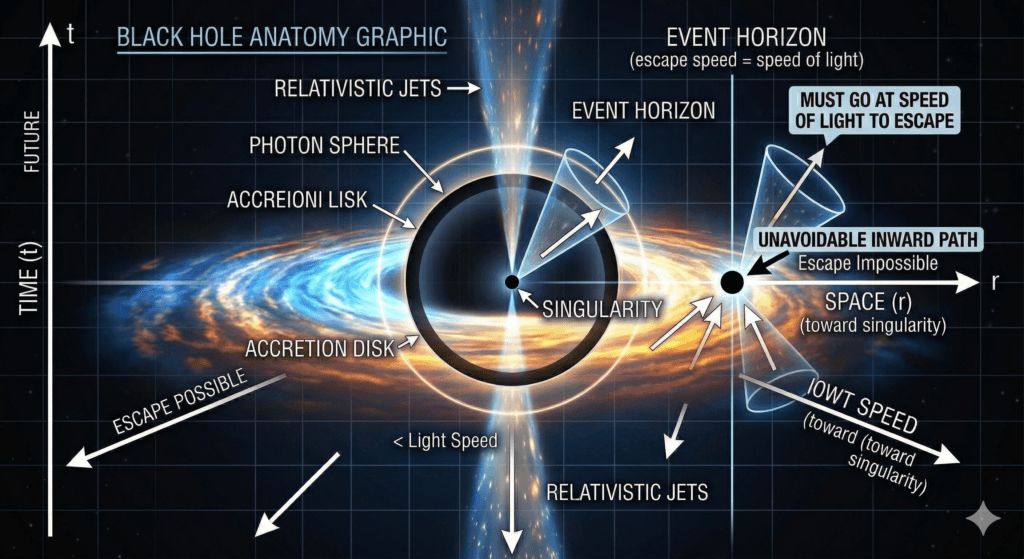
We can now place the event horizon inside the full “anatomy” of a black hole. NASA’s black hole anatomy pages describe the main regions:
- Singularity – The central point (or ring) where density and curvature become extreme in our current theory.
- Event horizon – The one‑way boundary where escape becomes impossible.
- Photon sphere – A region just outside the horizon where light can orbit the black hole in unstable circular paths.
- Accretion disk – A hot, glowing disk of gas spiraling into the black hole, often visible in X‑rays and radio waves.
- Jets – Beams of fast particles launched along the black hole’s spin axis in some systems.
How to sketch Diagram 3:
- Center: small black circle labeled “singularity.”
- Around it: thicker dark ring labeled “event horizon.”
- Slightly farther out: thin ring labeled “photon sphere.”
- In the equatorial plane: bright doughnut‑shaped ring labeled “accretion disk.”
- Up and down from the center: narrow cones labeled “relativistic jets.”
In this picture, what is an event horizon simple explanation becomes: it is the inner dark ring between all the visible activity (disk and jets) and the hidden singularity. Everything interesting we see around a black hole happens just outside this boundary.
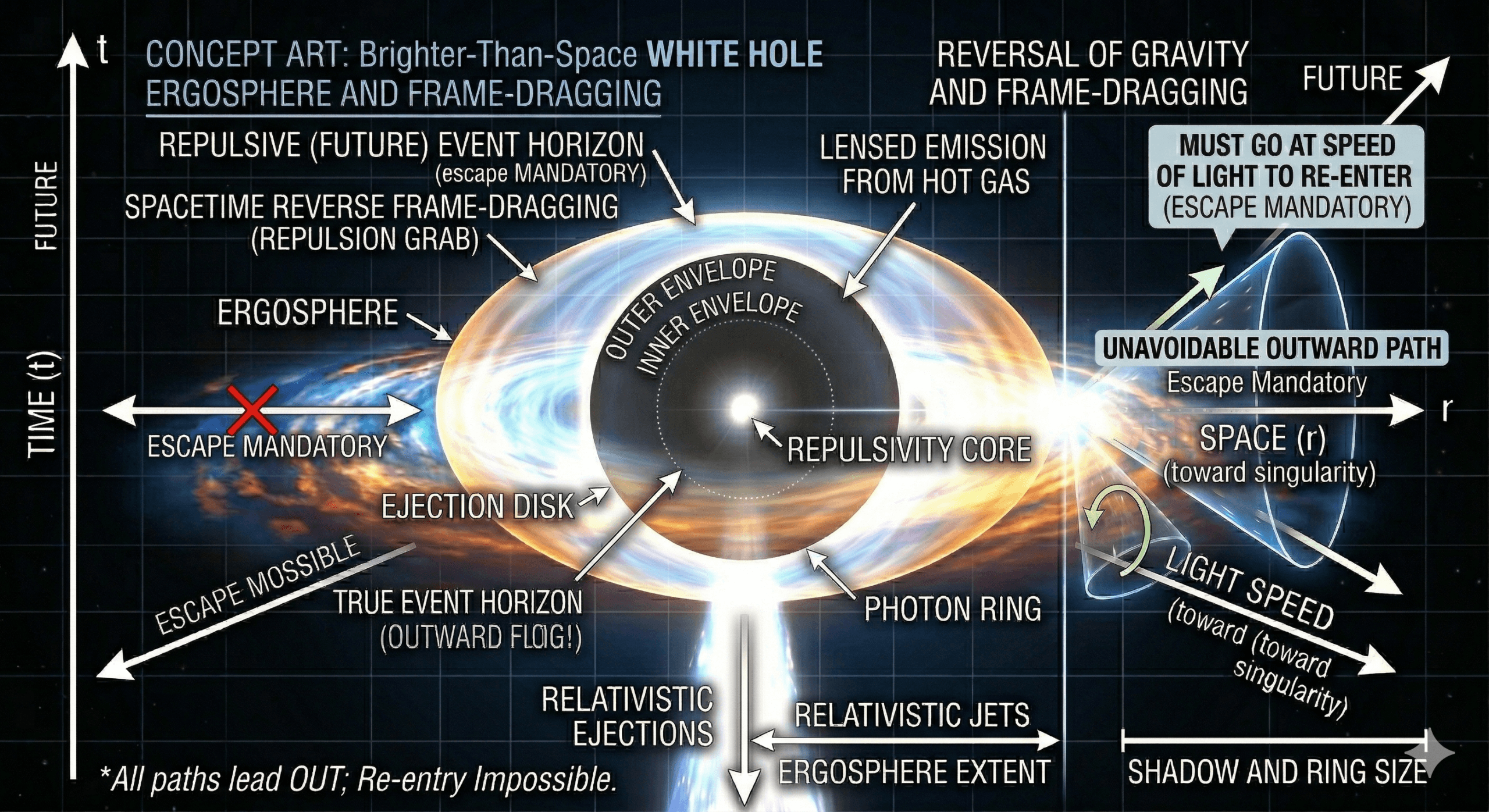
Diagram 4: Spinning Black Holes, Ergosphere, and Event Horizon
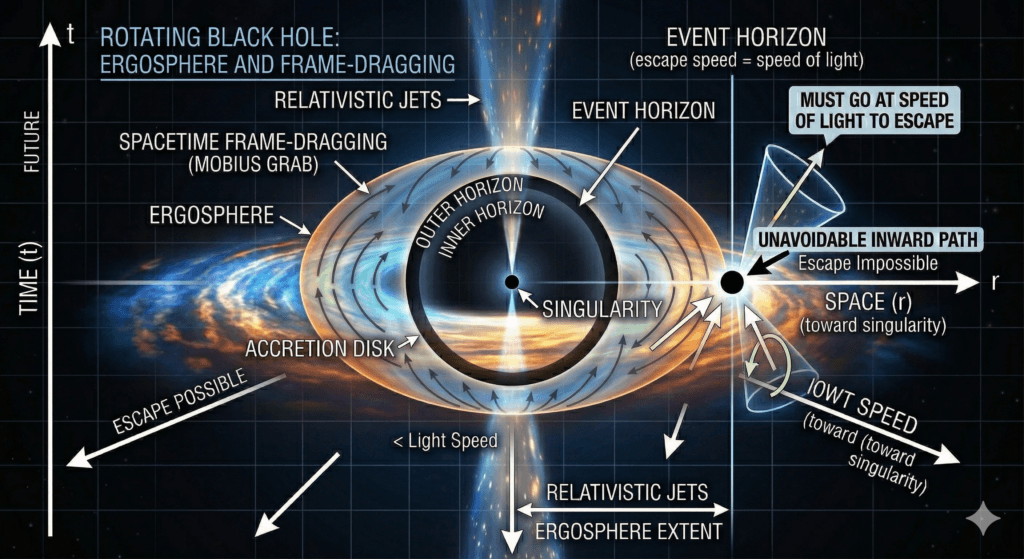
So far we have focused on non‑rotating black holes. Real black holes almost certainly spin, which adds another region outside the event horizon called the ergosphere.
In a spinning (Kerr) black hole:
- The event horizon is still the one‑way boundary.
- Just outside it lies the ergosphere, where spacetime itself is dragged around (frame dragging).
- Inside the ergosphere, objects cannot stand still with respect to distant stars; they are forced to co‑rotate.
The ergosphere touches the event horizon at the poles and bulges outward at the equator, giving it an oblate (flattened) shape.
How to sketch Diagram 4:
- Draw an inner dark circle (event horizon).
- Around it, draw a larger, stretched “pumpkin” shape touching the horizon at top and bottom, labeled “ergosphere.”
- Add arrows showing spacetime being dragged around within the ergosphere.
This diagram refines what is an event horizon simple explanation: the event horizon remains the true point of no return, while the ergosphere is an outer region where energy extraction and frame dragging occur but (in principle) escape is still possible.
Diagram 5: Event Horizon Shadow and Real Images
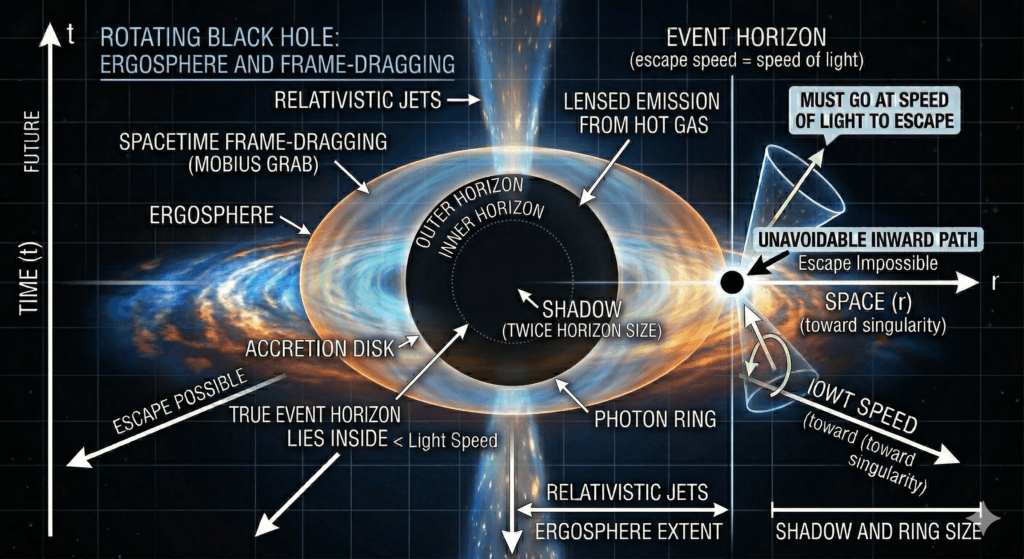
You might ask: “If the event horizon is invisible, how did we get images of black holes?” That question is central to what is an event horizon simple explanation today.
The Event Horizon Telescope (EHT) does not photograph the horizon directly; it images the bright gas around it and the shadow cast by the event horizon and surrounding curved spacetime.
- Light passing too close to the black hole falls in through the event horizon and disappears.
- Light just outside that region gets bent by gravity, forming a bright ring around a dark center.
- This creates a “shadow” about twice as wide as the actual horizon, as NASA notes.
How to sketch Diagram 5:
- Draw a dark circle in the middle labeled “shadow (twice horizon size).”
- Surround it with a bright uneven ring labeled “lensed emission from hot gas.”
- Note that the true event horizon lies inside the dark shadow, slightly smaller.
The famous 2019 image of the supermassive black hole M87* and later images of Sagittarius A* are real‑world confirmations of what is an event horizon simple explanation predicts: a dark central region defined by the horizon, surrounded by strongly lensed light.
What Happens When You Cross the Event Horizon?
Once you understand what is an event horizon simple explanation, the next question is: what happens if something crosses it?
From far away:
- An object falling toward the black hole appears to slow down as it approaches the event horizon.
- Any light it emits gets stretched to longer wavelengths (redshifted) and dimmer.
- To a distant observer, it never quite seems to cross; it just fades and freezes near the horizon.
From the falling object’s point of view:
- It crosses the event horizon in a finite time and notices no sharp “wall” there—local physics behaves smoothly at that point.
- Once inside, all possible future paths inevitably lead toward the singularity. There is no way to turn around or signal back out.
For small black holes, tidal forces near the horizon might be strong enough to cause spaghettification—stretching and squeezing the object. For supermassive black holes, the event horizon can be so large that tidal forces at the horizon itself are relatively gentle; you might not feel extreme stretching until you are well inside.
Either way, crossing the horizon is a one‑way trip. This is the physical heart of what is an event horizon simple explanation: it is a boundary you can cross inward but never outward.
Event Horizon vs Other Cosmic Horizons
The phrase “event horizon” sometimes appears in other contexts, so it helps to compare:
- Black hole event horizon – One‑way boundary around a black hole beyond which nothing can escape to infinity.
- Cosmological horizon – The maximum distance from which light could have reached us since the Big Bang, set by the finite age and expansion of the universe.
- Rindler horizon – An apparent horizon experienced by an accelerated observer in flat spacetime.
In all cases, a “horizon” is a boundary in spacetime that limits which events can influence a given observer. But when most people ask what is an event horizon simple explanation, they mean the black hole case: the surface where escape becomes impossible.
Why Event Horizons Matter in Modern Physics
Event horizons are not just cool graphics for sci‑fi—they sit at the center of deep theoretical puzzles. Understanding what is an event horizon simple explanation opens the door to big questions:
- Information paradox: If nothing escapes the event horizon but black holes evaporate via Hawking radiation, what happens to information that fell in?
- Quantum gravity: The breakdown of known physics at the singularity and possible quantum effects at the horizon hint at a deeper theory that unifies quantum mechanics and general relativity.
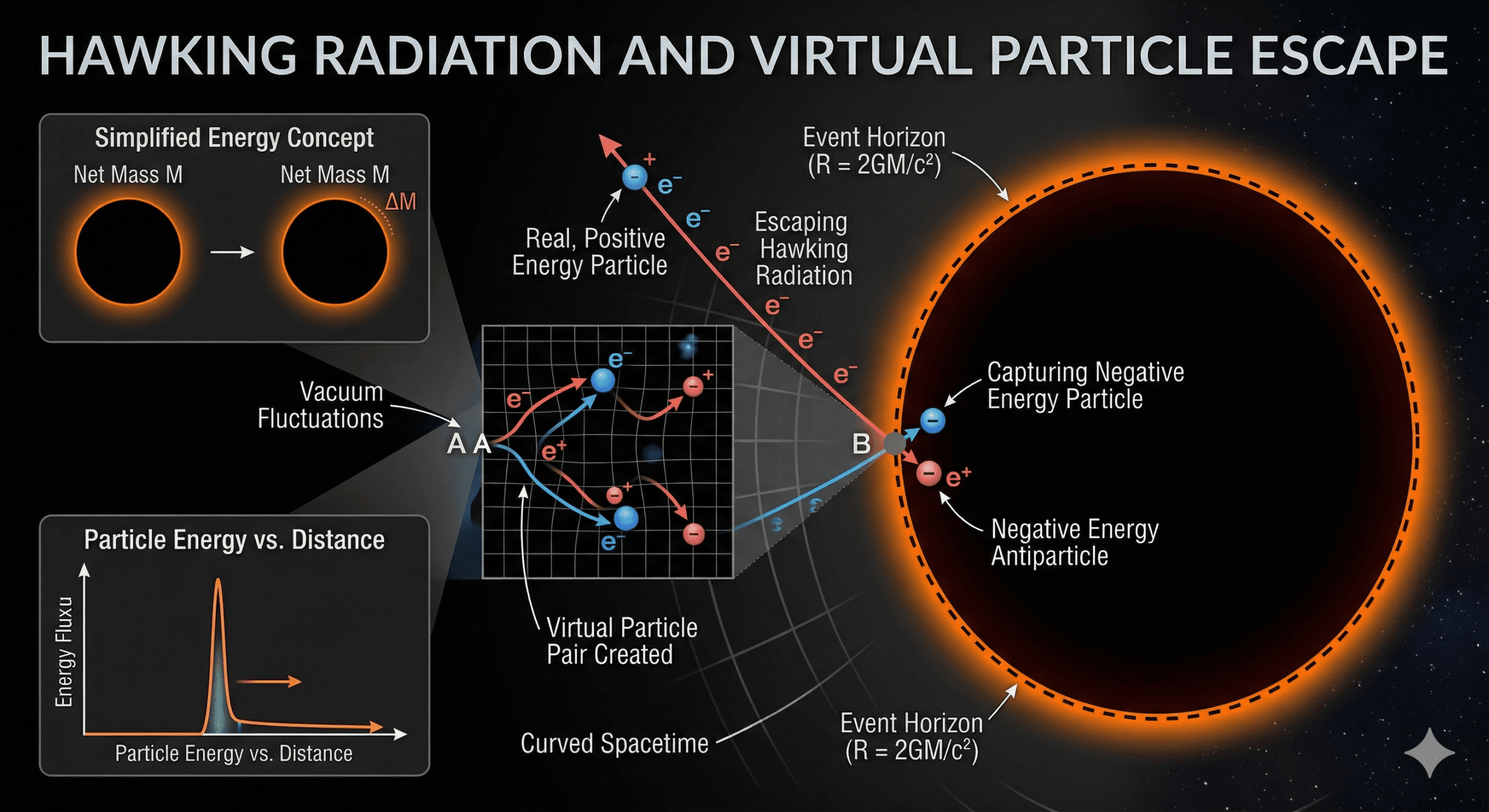
- Hawking radiation and black hole evaporation: Quantum processes near the horizon suggest black holes can slowly lose mass, making the long‑term definition of an event horizon subtle and linked to the entire spacetime history.
Because the event horizon is defined by the causal structure of spacetime and, in strict terms, by the entire future evolution of the universe, theorists say a black‑hole event horizon is teleological—it depends on the future, not just the present. This advanced idea sits behind the simple statement “nothing can escape,” giving even more depth to what is an event horizon simple explanation.
You now have a clear, visual answer to what is an event horizon simple explanation: it is the one‑way boundary around a black hole where escape speed reaches the speed of light, light cones tip entirely inward, and all future paths lead to the singularity. Real images from the Event Horizon Telescope, plus decades of observations and theory, show that event horizons are not just abstract math but real features of our universe.
1. What is an event horizon in simple words?
In simple words, an event horizon is the invisible boundary around a black hole where escape becomes impossible. Once you cross it, not even light can get back out, which is the core of what is an event horizon simple explanation
2. How is the event horizon different from the ergosphere?
The event horizon is the true one‑way boundary: nothing can escape from inside. The ergosphere is an outer region around a spinning black hole where spacetime is dragged around; objects there must co‑rotate but can still, in principle, escape. Knowing this distinction refines what is an event horizon simple explanation for rotating black holes
3. Does everything get crushed at the event horizon?
Crushing happens deeper in, near the singularity; the event horizon itself is just the boundary. Tidal forces at the horizon can be mild for supermassive black holes, so you might not feel anything special while crossing, even though you can never come back.
4. How do scientists study the event horizon if nothing escapes it?
Scientists study what an event horizon is by looking at:
The motion of stars and gas just outside it.
The shape of the shadow seen by radio telescopes.
Gravitational waves from black hole mergers.
All of these observations match general relativity’s predictions about event horizons.
5. Is the event horizon a physical surface?
No. The event horizon is not a solid surface; it is a mathematically defined boundary in spacetime. Nothing special happens to local matter right at the horizon in classical relativity—it can pass through smoothly—even though the horizon completely changes what paths are possible in the future
6. What happens to time at the event horizon?
From far away, clocks near the event horizon appear to slow down and signals from them are redshifted and fade away. From the falling object’s own frame, time flows normally as it crosses; what is an event horizon simple explanation here is: different observers disagree on the apparent crossing, but everyone agrees escape is impossible once inside.
7. Can we see an event horizon?
We cannot see the event horizon directly, but we can see its shadow—a dark region created by light that falls in and by the gravitational lensing of light around it. The Event Horizon Telescope images of M87* and Sagittarius A* show this shadow, which is roughly twice the true horizon size.